2022 Yearbook

Cotton processing and ginning

Background

The Cotton, Textile and Apparel (CTA) industry is remains largely labor-intensive and employs both semi-skilled and un-skilled workers and hence a key contributor to rural livelihoods. Specifically, about 200,000 households and an estimated 40,000 farmers rely on proceeds from cotton growing.

The value chain includes cotton production, ginning, spinning, and weaving, apparel production and output sales and marketing.

Export Processing Zone (EPZ)-based manufacturers employ 52,000 people in the related apparels sub-sector of the cotton industry of which about 21,000 people are formal workers.

Major inputs include fibers (natural/man made), dyes, chemicals, yarns, threads, fabrics, utilities such as water, electricity and fuel, machinery and skilled and semi-skilled labor. Cotton growing in Kenya is mainly undertaken by small-scale farmers.

Interventions by the Government under the Third Medium Term Plan (MTP III) are bearing fruit. Policy reviews and legislative changes have improved the cotton growing ecosystem alongside the revival of Rivatex.

Among the key policy interventions was the introduction of the hybrid BT cotton variety, which has been genetically modified to produce a natural pesticide to combat pests, including African bollworm, which causes the greatest damage to farmers.

By planting BT cotton, farmers are seeing huge savings in cost of pesticides to control pests, leading to more earnings and higher yields. BT cotton is genetically enhanced by incorporating a gene derived from soil-dwelling bacteria.

With the assurance of a ready market by Rivatex, more farmers have been encouraged to increase cotton production. Following Government investment in Rivatex, the factory now has the capacity to consume 10,000 bales of cotton and is committed to buying all the locally planted crop.

A Government directive also requires state agencies to buy locally tailored fabrics.

Ginneries in Embu and Kirinyaga that were long-dormant now have a new lease of life.

The revival of cotton is creating employment in the textile sector and is expected to eventually reduce the influx of second-hand clothes also known as Mitumba.

The Government has already trained 50,000 youths and women in the production of the crop and established five million square feet of industrial sheds. This is expected to increase revenue from KSh3.5 million to KSh200 billion, create 500,000 cotton-related jobs and other 100,000 from the apparel sector by 2022.

Farmers in Mwea have harvested more cotton than previously at the rate of three times the conventional varieties with a shorter maturity period of between 130 to 180 days. Whereas average yields from the conventional cotton seed are 250kgs per acre, BT cotton yields average 7000kgs per acre.

Increased cotton production will spur the manufacturing sector through the provision of raw materials for the cotton value chain, including ginners, spinners, textile mills and apparel manufacturers, and create jobs for youth and women.

Annual local demand for cotton is 140,000 bales with a potential to grow to 260,000, yet the industry is producing a mere 21,000 bales annually. The commercialisation process started in 2011 culminating in a conditional approval from National Biosafety Authority in 2016 to Monsanto Company who owns the BT technology.

The National Environment Management Authority (NEMA) gave Monsanto a clearance certificate after conducting an environment impact assessment (EIA).

A 12-member taskforce set up by the ministries of Agriculture and Industrialisation Trade and Enterprise Development selected nine sites for national performance trials of BT cotton at Bura, Katumani, Mwea, Perlera, Kampi ya Mawe, Matuga, Kibos, Alupe and Barwessa.

In addition to higher yields, the industry benefits from improved cotton quality and export revenues.

In Homa Bay County farmers are reinvesting in cotton through their co-operative society and have acquired land to put up a modern warehouse and office and eventually a new cotton ginnery.

National Agriculture and Rural Inclusive Growth Project (NARIGP), supported the Cotton Cooperative Union to by the 2.5-acre land in Magare Village within Homa Bay town.

A similar revival is ongoing in the Kerio Valley in Baringo County following the signing of an MOU between the county and the Moi University-owned Rivatex. Farmers there are setting up a cooperative to deal directly with the buyers and eliminate middlemen

Farmers in the area, which is classified as semi-arid, would have greatly benefited from the Kimwarer and Arror dams whose construction was halted due to alleged corruption.

The Government established one thousand cotton demonstration farms in 23 cotton-growing counties ahead of the commercialisation of BT cotton.

Each demonstration farm was to train at least 40 farmers and create a pool of 40,000 cotton farmers as catchment for BT cotton with a target of 200,000 acres under BT cotton cultivation by 2022 hence creating over 2,500 jobs for Kenyans along the value chain.

This is going in tandem with the strengthening of smallholder farmers’ cotton development organisations’ governance and leadership capacities in their co-operatives, modernisation of cotton ginneries and establishment of new ones to enhance value addition.

For the programme to succeed, farmers are being encouraged by the Co-operative Department to form co-operative societies so as to enjoy economies of scale.

Kenya was the seventh country in Africa to adopt the BT cotton after South Africa, Sudan, Ethiopia, Malawi, Nigeria and Eswatini.

Commercial farming of BT Cotton would have been impossible without the lifting by the Cabinet of a Government ban for importation of GM foods imposed in 2012.

The first trials on the crop were carried out in 2001 at then Kenya Agricultural Research Institute (KARI), now Kenya Agricultural Research and Livestock Organisation (KARLO), Mwea Centre.

Increased cotton production will spur the manufacturing sector through provision of the much-needed raw material for the cotton value chain, including ginners, spinners, textile mills and apparel manufacturers while creating jobs for the youth and women.

Overall, this will improve rural incomes and reduce poverty while contributing to the realisation of the Big 4 Agenda in respect to manufacturing.

Among the key drivers of the manufacturing sector under the Big Four agenda is cotton and textiles which makes the commodity as a strategic crop for communities in the marginal areas and mainly grown in smallholder farms.

Other envisaged measures include, buying domestically grown cotton, improving governance in the import rules for textile products to cushion local producers and providing incentives to investors to build modern ginneries and textile manufacturing plants.

Once the Fiber Crops Development Authority Bill becomes law, the cotton industry will be even more invigorated. It will allow the Government to promote and market fibre crops and products meaning that the cotton, textile and apparel subsectors will be unstoppable.

Globally, 15 countries are currently growing GMO cotton covering an area of 24 million

hectares. Kenya is the latest entrant joining other African countries namely, eSwatini.

Key cotton industry inputs

Major inputs include fibres (natural and man-made), dyes, chemicals, yarns, threads, fabrics, utilities such as water, electricity and fuel, machinery, and skilled and semi-skilled labor.

Annual lint production

This currently stands at only about 20,000 bales.

Cotton ginning

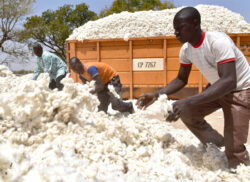
Ginning separates seed cotton into lint and cotton seeds. Ginneries are a focal point in the cotton industry and their location, efficiency and organisation are critical to it. The ginner’s objective is to produce lint of satisfactory quality and to gin the cotton with minimum effect on fiber spinning quality. There are 24 ginneries in the country, with an installed capacity of approximately 140,000 bales annually. Out of the 24 registered ginneries, only about 10 ginneries are currently operational.

Textile mills and value addition

Revival of Kenya’s leading textile factories among them Rivatex, Thika Cotton Mills and Ken Knit is a deliberate and sustained Government strategy aimed at benefitting cotton farmers, growing local industries and creating jobs for the youth.

Cotton farmers in Kerio Valley in Elgeyo Marakwet county signed a deal with Rift Valley Textiles (Rivatex) East Africa Limited in 2019 for the factory to buy their produce, providing them with a guaranteed market and income and cutting out exploitative middlemen.

Rivatex was also to supply the 300 farmers with certified disease-resistant and high yielding BT cotton seeds. The Moi University-owned textile miller penned a memorandum of understanding with the administration of the Kericho county government.

This will see Rivatex supply farmers through their co-operative societies with certified cotton seeds and work with the county government on training and research.

The company undertook a KSh6 billion upgrade in 2019 as it targeted regional and international markets. The upgrade raised its capacity from 10,000 bales of cotton per day to 100,000 bales.

Rivatex used loans from the National Treasury and Government of India to replace obsolete machinery and is under contract by several state agencies to produce uniforms including the National Police Service, hospitals and the Geothermal Development Company among others.

Government policy for reviving the cotton and textile industries includes making Nakuru County a key textile hub in East and Central Africa, and the recent elevation of Nakuru to city status will only improve its attractiveness for potential investors.

Nakuru County is already home to a host of textile firms, including Bedi Investments Limited, Trendy Links Limited Spin-Knit Limited and Nakuru Industries Limited. The county government is also seeking investors to set up apparel and textile factories in the Naivasha Special Economic Zone.

In Kiambu County, Thika Cloth Mills has been reaching out to farmers in Machakos County to revive cotton growing in the arid Yatta and Masinga sub-counties. The farmers have signed a memorandum of understanding with TCM that will see the latter supply them with free seeds, fertilisers and pesticides and has already begun buying their cotton.

Plans are also underway to revive Mount Kenya Textiles (Mountex) in Nanyuki and Kisumu Cotton Mills (Kicomi) with the cost initially put at Sh1 billion. The two can create at least 7,000 jobs between them.

Kisumu National Polytechnic is among institutions benefiting from a World Bank KSh1.3 billion grant to become a centre of excellence for training in textile technologies in partnership with other technical and vocational training institutions to support the cotton industry value chain. This is under the under the World Bank’s East Africa Skills for Transformation and Regional Integration Project (EASTRIP).

The idea is to work with all parties along the value chain, including farmers, small and medium enterprises, technicians and researchers to make the sector vibrant once again while making textile products that meet international standards.

With a planned Special Economic Zone in the pipeline for the city of Kisumu, the institution has also signed a memorandum of understanding with Rivatex East Africa Limited.

For county governments, Kitui County Textile Company (KICOTEC) which is owned by the County Government of Kitui has set the pace, creating much needed jobs and market for the cotton industry in the county.

KICOTEC cashed in on a National Government directive requiring government agencies to buy locally made fabrics and apparel to snag a lucrative multimillion-shilling contract to tailor government uniforms for chiefs and their assistants countrywide.

It then followed this up with a certification from the Kenya Bureau of Standards (KEBS) to produce personal protective equipment (PPE) personal protective equipment for all public hospitals in the face of the COVID-19 pandemic. These included coveralls and masks which are essential for healthcare workers.

Textile mills convert fibres to fabrics through spinning, weaving/knitting and fabric finishing. Yarn Spinning: Cotton lint among other fibers goes through spinning to produce yarn. The yarn is then weaved or knitted to produce different types of fabric. Only 15 out of 52 yarn mills are operational at 40-50 per cent of installed capacity. Yarn and thread output are sold in Kenya and exported to Uganda, Rwanda and Tanzania, among others.
 

Policy development & implementation

State Department for Industrialisation: Policies and Legal and Regulatory

Framework, Special Economic Zones Act 2015

  •  Review of the Special Economic Zones Policy
  • Amendment of the Special Economic Zones Act No.16 of 2015
  • Review of the Sessional Paper No. 9 of 2012 on National Industrialization Policy (NIP)
  • Development of the National Manufacturing Policy and Strategy
  • Review of Intellectual Property Rights Policy
  •  Finalization of the Intellectual Property Bill, 2020 and enact it into law
  • Development of the Quality and Standards Policy
  • Review of the Micro and Small Enterprises Authority Policy
  • Review of the Micro and Small Enterprises Act, 2012
  • Finalization of the Kenya Leather Development Policy
  • Implementation of the Kenya Investment Policy 2019
  • Development of the Local Content Policy Sector Guidelines
  • Development of the Local Content Act
  • Review of the Investment Promotion Act, 2004
  • Enactment of the KIRDI Bill 2020
  • Finalize the Iron and Steel Policy
  • Finalize development of the incubation and sub-contracting policies

Legal Metrology Bill 2017

Provides for the manufacture, sale and use of weighing and measuring equipment in trade, health and safety, environment and the sale of goods, in line with international best practices.

Provides for administration of legal metrology services in the devolved system of government and for connected purposes.

Trade Descriptions Bill 2020

Prohibits false trade descriptions in the sale of goods, and provision of services, accommodation and facilities in the course of trade

Prohibits false or misleading indications as to price and the supply of goodsProhibits the importation of goods bearing false indication of the place of origin and to confer powers for the enforcement and making of orders relating to the marking or to accompany the goods or to be included in advertisement

Draft Micro and Small Enterprise Development Fund Regulations, 2020, National Co-operative Development Policy

Formulated under the theme “Promoting Co-operative Societies for Industrialisation

Seeks to transform co-operatives into vibrant social and commercial entities.

Identifies contemporary challenges limiting the growth of co-operative societies

Offers solutions towards a more proactive engagement between the national government, county governments, the co-operative movement and other stakeholders in addressing co-operatives’ challenges.

Streamlines the role of national and county governments in co-operative development in line with the Constitution of Kenya, 2010 and national development goals set out in Kenya Vision 2030.

Draft National Automotive Policy

Seeks to streamline the motor assembly industry to phase out the importation of second-hand vehicles by 2026.

The National Industrialisation Policy

  • Focuses on value addition for both primary and high valued goods
  • Identifies linkages between industrial sub-sectors and other productive sectors to drive the industrialisation process
  • Creates enabling environment for private sector-led industrial development
  • Creates a business environment friendly to potential and current local and foreign investors
  • Highlights need to promote resource-based industries, in particular, labour intensive, export-oriented ones, for increased productivity and growth in all the industrial sub-sectors
  • Encourages sustainable creativity and innovation to improve production processes and the quality of products
  • Encourages development of appropriately skills in industrial human resource to enhance competitiveness
  • Identifies the foundational pillars and measures for the vibrancy and growth of the industrial sector
  • Recommends appropriate policy interventions for the realisation of the sector goals
  • Provides a legal and institutional framework for substantial improvements in intra-governmental coordination, under a Public Private Partnership arrangement.

Scrap Metal Act 2015

Regulates dealings in scrap metal and establishes the Scrap Metal Council

Micro and Small Enterprises Act (No.55 of 2012)

Targets businesses with an annual turnover of less than KSh500,000 or companies that employ less than 10 people and manufacturing plants with an investment and capital base of less than Kshs 10 million.

Created the National Council for Small Enterprises in the Ministry of Labour mandated with marketing goods and services of SMEs to both the local and international markets. It is also the link between Government and the enterprises.

Establishes a credit Bureau for SMEs keen on expansion to access credit and financial services and free financial advice.

The Export Processing Zones Authority Act

Establishes export processing zones and the Export Processing Zones Authority

Provide for the promotion and facilitation of export-oriented investments and the development of enabling environment for such investment and for connected purposes

Achievements

Kenya ranked 56th globally in the World Bank’s Doing Business 2019 report, rising 80 places since 2014 – one of the most improved countries in Africa and globally.
Infrastructure Facilities for Ngozi Kenya Leather Park at Kinanie, Machakos County:

Construction of a 500-acre leather cluster host services to promote the sector including:

  • 5-6 leather footwear manufacturers
  • 8-10 leather tanneries
  • 3-4 packaging and logistics company
  • A small and medium enterprise (SME) park
  • Training centre for increased value addition
  • Low costs of labour and electricity
  • EPZ benefits on taxation and trade
  • Integrated amenities – residential complex, schools, health facilities, recreation centre
    Ongoing construction almost complete
  • Will create investment opportunities in local leather industry including value added services
  • Will create an estimated 35,000 jobs and add USD 150-250 million to Kenya’s GDP
  • Will contribute to substitution of shoe imports worth USD 86 million annually and reduce exports of semi-processed leather
  • Will reduce smuggling of raw hides and skins and influx of illicit leather in the market

USD 50 million Kenya Industry Entrepreneurship Project (KIEP)

Component 1

Strengthen innovation and entrepreneurship by boosting capacity of incubators, accelerators, and rapid technology skills providers (collectively called ‘intermediaries’).

Connect the sector to international talent and support infrastructure

Foster links between startups and traditional industry.

Bridge gaps in technical skills by linking young talent and academia to the private sector

Component 2

Provide managerial and technical skills training and access to technology for Small and Medium Enterprises (SMEs) to improve their productivity

Component 3

Provide communications and Monitoring and Evaluation (M&E) support to SMEs.
Component 1 of project ongoing

Components 2 of project launched and ongoing with 250 SMEs participating

Ministry launched Startup Savanna, an international business acceleration programme linking Kenyan startups to global angel investor and business support resource networks, including global network of events, accelerators and incubators, mentors, investors, and corporate partners attracting much needed technical expertise and funds to enable them to scale their operations within and beyond Kenya.

Free Trade deal with US to open bigger market for participating SMEs, making up for the expiry of the Africa Growth and Opportunity Act (AGOA) in 2025

SMEs gaining managerial and technical skills necessary to improve their capital and upgrade their machinery and equipment for more productivity

Project is fostering innovation in SMEs and promoting market linkages to the best specialists
Micro, Small and Medium Enterprises Competitiveness Project seeks to increase productivity and employment in SMEs through:

  • Access to finance
  • Improved business environment
  • Strengthened enterprise skills and markets linkages to meet the demands of SMEs
    The Project met development objective outcomes with satisfactory overall implementation. Its achievements include:
  • Development of new financial products for SMEs such as Asset Financing, receipt warehousing, weather insurance, credit referencing, deposit taking by Micro Financial Institutions and Cooperative Societies and two financial access (Finances) studies undertaken.
  • Over 47 pilot projects undertaken in the cotton, coffee, leather and pyrethrum value chains thereby increasing productivity and competitiveness through implementation of Good Agricultural Practices (GAPs) and certification of co-operatives.
  • Establishment of the Cotton Development Authority (CODA) and the Kenya Leather Development Council.

Over 1,000 Small and Medium Enterprises (SMEs) and Micro, Small and Medium Enterprises (MSMEs) to benefit from an ultra-modern laboratory, calibration and testing facility to be set up by the Kenya Bureau of Standards (KEBs) in Nakuru County. The facility will reduce turnaround time for testing and associated costs as samples will be tested locally instead of being ferried to Nairobi. KEBs will also use the proposed facility to train small and medium-sized enterprises (SMEs) on standards and certification, to increase their compliance levels and enhance chances of getting their products certified upon submission of samples. Facilities will be equipped with four laboratories: Food and Agriculture, Microbiology, Biochemistry, and Instrumentation. Laboratories will offer testing, metrology, and calibration services to the industries in Rift Valley region and speed up issuance of the Standardization Mark to Small and Medium Enterprises (SMEs) and Micro, Small and Medium Enterprises (MSMEs), within the devolved unit and over 14 other counties in the region.

Test Procedures for five (5) selected electrical appliances completed and submitted to KEBS

Minimum Energy Performance Standards for five (5) selected items drafted and submitted to KEBS for mainstreaming and Gazettement

Undertook awareness campaigns through trade fairs/shows and media publication on Energy Efficiency Standards and Labelling

Carried out the Medium-Term Evaluation (MTE) and made recommendations to guide the remaining part of the programme.

Implementation of the Kenya Youth Employment and Opportunities Project (KYEOP) in partnership with the ministries of ICT Innovation and Youth Affairs and Labour and Social Protection and supervised by the Kenya Private Sector Alliance (KEPSA).

Cycle 5 launched and underway. Government allocated KSh400 million for training of successful candidates in 17 counties, before receiving grants to start their businesses. Counties include Mombasa, Kilifi, Nairobi, Nakuru, Kiambu, Nyandarua, Mandera, Turkana, Wajir, Bungoma, Kakamega, Kwale, Kisumu, Kisii, Machakos, Kitui and Migori.

Over 30,000 youth have received training and internship in both the formal and informal sector out of which an estimated 75 per cent have secured employment.

Business support beneficiaries have received grants of KSh40,000 each while others have received business support services

750 youth-owned enterprises financed through Business Plan Competition dubbed ‘MbeleNaBiz’ under KYEOP to the tune of KSh1.3 billion.

Four organisations received KSh120 million from the FutureBora Innovation Challenge launched in October last year for creating income-generating opportunities for orphaned youths and those affected by conflict, persons living with disabilities, young single mothers, street youths and those from vulnerable and marginalised communities. The four are Afya Research Africa, Hydroponics Africa Limited, Life in Abundance-Kenya, and TakaTaka Solutions Limited

County Youth Sector Working Groups (CYSWG) inaugurated by Ministry of ICT Innovation and Youth Affairs to prioritize youth empowerment programs in the county including access to KYEOP.


Trade apparels and leather

Background

The Ministry of Industrialisation Trade and Enterprise Development prepared and approved Kenya’s first ever comprehensive industrialisation road map, which identified the following priority areas under the Third Medium Term Plan (MTP III):

  • Critical sectors with scale such as Tea, Cut Flowers, Coffee and Horticulture
  • Leveraging of natural advantages to create competitive sectors that include textiles and cotton; Leather; Agro-processing; Beef; and Fishing
  • Building of local industry to support resource and infrastructure investments in areas such as Oil; Minerals; Infrastructure (e.g.  iron and steel); and Geothermal
  • Transforming and reviving industries including Pan Paper Mills, Sugar, Coffee, Coconuts, Cashewnuts, Livestock and Pyrethrum
  • Enhancing non-industrial job-creating sectors in ICT, Retail and wholesale trade and Tourism
  • Improving the ease of doing business in Kenya
  • Supporting sectors for growth: skills, infrastructure (Special Economic Zones, Free Trade Zones), and finance.
  • Manufacture of Industrial and Agro-processing machinery, equipment, parts and tools
  • Manufacture of electrical products and electronics
  • Manufacture of automotive parts and motorcycles,
  • Unlocking the potential of SMEs: Small and medium enterprises (SMEs) in Kenya’s manufacturing sector are enterprises with fulltime employees numbering not more than 100, or with an annual sales turnover not exceeding KSh150 million. Developing competitive and resilient SMEs is integral to Kenya’s ambition to be a globally competitive and prosperous nation with a high quality of life by 2030
  • Developing a compelling FDI attraction plan

These are key to creating jobs and attracting local and foreign investments. By promoting value addition, Kenya is moving closer to establishing a competitive manufacturing hub in the region and Africa. The priority areas under Manufacturing are cotton, textiles and apparels, leather and leather products, agro-processing and construction materials.

Having set a target of establishing at least 3,850 new manufacturing enterprises through industrial financing and other incentives, the focus is to increase export earnings from textiles and apparels production.

Key milestones

Special Economic Zones (SEZs): the zones containing free trade zones, industrial estates, export processing zones (EPZs), free ports and enterprise zones have been gazetted.

Infrastructure in Athi River Textile Hub upgraded

Common Effluent Treatment Plant completed at Kenya Leather Industrial Park at Kenanie. This is a key attraction to investors in leather processing.

Modernisation of KIRDI laboratories: this ongoing.

Modernisation of Rivatex Limited: this has been completed leading to increase in fabrics production and boosting local growing and processing of cotton.

Construction of Industrial Sheds at Athi River EPZ Textile Hub: these were completed leading to increases inflow of FDI (foreign direct investment), creation of jobs and higher export.

Loans advanced to Micro and Small Enterprises (MSEs) by Kenya Industrial Estates and large firms by IDB Capital and ICDC

Upgrading of Training and Industrial Centre for Shoe Industry in Thika

Registration of patents, utility models, industrial designs and trademarks

Cycle 5 of the Kenya Youth Employment and Opportunities Project (KYEOP): this is ongoing and has equipped many youths with skills to secure self-employment and earn livelihoods. It was launched in partnership with the Ministry of ICT, Innovation and Youth Affairs and the World Bank.

Buy Kenya Build Kenya Policy Initiative: it will ensure that all government agencies promote local production by buying Kenyan products and thus promote the manufacturing sector. Terms of reference for the development of the policy have been formulated and a technical committee chaired by Kenya Association of Manufacturers formed with oversight by the Ministry

Ease of Doing Business: The Ministry is championing reforms to improve the ease of doing business climate for investors. Kenya currently ranks 56th globally and 3rd in Sub-Sahara Africa on the Ease of Doing Business.  The goal is to improve Kenya’s ranking in ease of doing business rankings going forward. The Government’s objective is to improve the county’s Doing business ranking to be among the top 30 nation’s globally and attainment of 25th status in the next decade.   To this end, work is already on-going and results will be evident in the next 24 months where we expect the country’s ranking to improve significantly.

Enterprise Development: 188 Constituency Industrial Development Centres (CIDCs) are being operationalised in partnership with the Medium and Small Enterprises Authority (MSEA), Kenya Industrial Research and Development Institute (KIRDI), the cooperative movement, development partners and county governments, with the aim of industrializing the rural areas as a way to attaining a nationally integrated industrial value chain. Several trainings, using the model of the International Labour Organisation/Youth Enterprise Program (ILO/YEP) programme, were carried out by Ministry on how to start and Improve Your Business (SIYB).

Pilot Soya Bean Processing Plants: To stem the import of Soya Beans that are used in the production of edible oils and production of soya milk, pilot soya plants have been operationalized in Kisumu, Migori and Bungoma with support from UNIDO. The Kisumu pilot plant is processing Soya Milk while the Migori and Bungoma plants are processing Soya Flour and by-products. Plans are underway to upscale the operations of these plants.

One Village One Product (OVOP): Through the OVOP programme, the ministry has been able to support 155 Micro and Small Enterprises (MSEs) with a total membership of 11,039 members to improve their businesses in honey, dairy, fruit and vegetables, flour and confectionery, herbal soap and lotions. Training in business management was undertaken and the MSEs linked to local and export markets through exhibitions and an OVOP website.

Value addition in cooperatives: The Ministry facilitated establishment of 11 coffee milling plants to promote value addition and enhance earnings to farmers. Through these initiatives, Coffee Cooperative Societies are exporting about 150,000 bags worth Kshs. 3 billion. In addition, pilot projects on value addition in Potato; Banana; and Honey were initiated. Farmers were mobilized to establish irrigation projects in Kitui and Machakos counties; and rehabilitation of irrigation system and restocking of animals in Godana Cooperative.

Reviving failed Industries: The Ministry is in the process of reviving struggling industries across the country. They include Panpaper Mills in Webuye and the revival of Rivatex, Thika Cotton Mills and Ken Knit among others


Projects by government to ensure achievement of manufacturing pillar in the big four agenda

Development of constituency industrial development centres

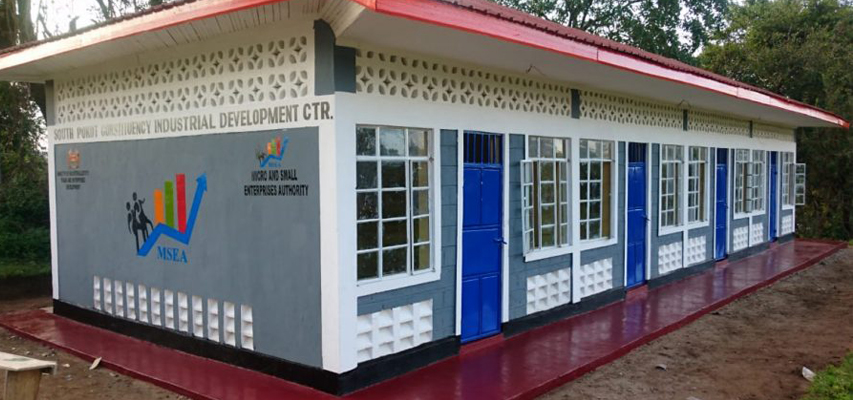
South Pokot Constituency Industrial Development Centre. The centres set up by Micro and Small Entreprises Authority are aimed at promoting industrial activities across the constituencies./MSEA

The main activity under this sector was the construction and equipping of Constituency Industrial Development Centres (CIDCs) in the 210 constituencies to provide worksites and tools for the youth to pursue gainful employment. A total of 188 constituencies out of the 210 identified land for the construction of CIDCs. The Ministry of Industrialization and Enterprise Development completed construction of 139 Constituency Industrial Development Centres in various constituencies while construction works for the remaining 49 centres are at various stages of implementation.

Two CIDCs: Kiambaa and Kitui Central have been equipped and are ready for launching. Management agreement contract has been signed between the Ministry of Industrialization and Enterprise Development and KIE to manage some of the CIDCs. Out of these, 47 CIDCs have been identified for upgrading into industrial parks in each of the counties. In conclusion, Kenya prepares to start oil exportation in the second half of 2023, as-a- matter-of-urgency; the government is establishing a framework that promotes implementation of sound fiscal, environment and compensation policies as well as enhancing good governance. Observing the experiences of Botswana, it is critical that Kenya gets it right from the beginning by adopting a combination of sound fiscal policy, environment, compensation and good governance as essential ingredients to avoid the resource curse phenomenon.

Transformation of the Kenya industrial training institute

The Government is transforming KITI to make it a center of excellence that provides quality training to support development of manufacturing and industrial development. Located on a 40-acre piece of land along Nakuru–Solai Road, 3kms from Nakuru town. KITI gives provides students with technical and entrepreneurship skills for self-employment. It trains artisans, craftsmen, technicians, engineering graduates, engineers and entrepreneurs to work in the existing industries and for self-employment.

Also trained are middle level managers for the industrial sector to carry out research in projects and products that can accelerate rural industrialisation. The institute also offers shorter courses for specific groups or clients (tailor made courses to meet client’s training requirements). The institute has 8 training departments most of which have adequate training space in form of workshops and classrooms.

SMEs competitiveness project

This project was initiated to increase productivity and employment in Micro, Small and Medium Enterprises (SMEs) through three components namely: access to finance, improved business environment and strengthened enterprise skills and markets linkages to meet the demands of SMEs. The project developed new financial products for SMEs such as Asset Financing, receipt warehousing, weather insurance, credit referencing, deposit taking by Micro Financial Institutions and Cooperative Societies.

Under the strengthening enterprise skills and market linkages component, over 47 pilot projects were undertaken in the cotton, coffee, leather and pyrethrum value chains, thereby increasing productivity and competitiveness through implementation of Good Agricultural Practices (GAPs) and certification of co-operatives. The pilot value chain matching grant, through the various Apex committees created in the identified value chains resulted into establishment of the Cotton Development Authority (CODA) and the Kenya Leather Development Council.

The Kenya industry and entrepreneurship project

The Kenya Industry and Entrepreneurship Project (KIEP) is a US$50 million project that will be implemented by the Ministry of Industrialization, Trade and Enterprise Development (MoITED) with support from the World Bank Group over the next six years between 2019-2024. KIEP aims to increase innovation and productivity in select private sector firms in Kenya by strengthening the private sector (including startups, SMEs, incubators, accelerators, technology Bootcamp providers, etc.) through financial grants and technical assistance. KIEP is fully aligned with Kenya’s Vision 2030 of transforming the country into a newly industrialized and globally competitive middle-income country.

The project aims to deliver this industrialization agenda by strengthening the entrepreneurship ecosystem, increasing firm-level innovation and productivity, and developing technically skilled talent in the country. Through support to select, high-potential SMEs, particularly in sectors such as manufacturing and agribusiness, the project aims to create a demonstration effect ensuring significant catalytic and cascading effects in the economy. This approach is envisaged to have a cross-cutting effect on each of the Big Four sectors of manufacturing, food security, affordable housing, and universal healthcare and also boost shared prosperity.

4K MSE 2030 programme

The goal of the 4K MSE 2030 programme is to modernize the Medium Small and Micro Enterprises (MSME) sector which had continually faced the challenges in building capacity for mass production through Innovation, design and product development, standardization and patenting for productivity, quality, competitiveness and marketing of SME products. The 4K MSE 2030 programme comprised 4 institutions namely: KIRDI, KEBS, KIPI and KNFJKA as partners. The main activity during the first MTP was the promotion of the upgrading of 50 products under this initiative.

Five products were identified for upgrading through reverse engineering. These were: Arc Welding Machine, Handloom, wheelbarrow, Transformer and Hospital bed. The programme upgraded Handloom, Arc welding machine and Hospital Bed from the SME sector. The upgrading of the handloom was meant to build capacity of women entrepreneurs in value addition in textile sector.

Food and Nutrition Security

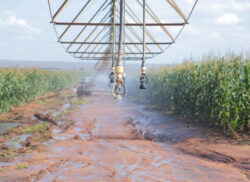
The 10,000-acre model farm at the Galana/Kulalu set up by the government with the aim of achieving Food Security. The Project is managed by the National Irrigation Authority.

The Government through the Economic Stimulus Programme (ESP) has subsidized the supply of farm inputs through the e-voucher system to reach 200,000 small scale farmers. The Government has made progress in increasing land under irrigation through construction of over 200 irrigation projects across all 47 counties; rehabilitation, expansion and modernization of public irrigation schemes resulting in increase in the area under irrigation from 23,326.5 acres to 35,326 acres; construction of 47 water pans with a combined volume of 2,600,000 cubic meters in arid areas for domestic, animal consumption and irrigation in green houses. Up to 70,000 famers have benefited from the programme with water pans ensuring constant supply of water for irrigation.

Other projects which have significantly increased land under irrigation and boosted productivity are: (i) expansion of Galana Kulalu farm acreage from 52,000 to 100,000 acres(ii) the launch of Lower Nzoia Irrigation Project which targets 10,000 acres and (iii) rehabilitation of Bura Irrigation Scheme to increase land under irrigation by 9,000 acres Expansion of Mwea irrigation scheme by 10,000 acres, Lower Nzoia Irrigation Project and Lower Kuja Irrigation Development Project are expected to increase rice production by 160,000 tonnes

Iron and steel

The local steel industry remains heavily dependent on imported raw materials, as no local sources have been developed to date making the manufacture of steel locally quite expensive. Reducing this high import bill is possible if high quality steel can be produced more cheaply locally. The government’s strategies to promote the sector include readiness to facilitate investments in commercial exploitation of iron deposits in the country and setting up a Scrap Metal Council to regulate the scrap metal industry which is important in the sector.
Numerical Machining Complex (NMC) has been identified as a focal point for promoting development of iron and steel industry. The NMC will be transformed to be able to realize its full potential in supporting the development of iron and steel sector. Kenya has iron ore reserves in the counties of Taita Taveta, Kitui and Tharaka that can support steel production. The Government has approved a partnership between South Korean steel maker PSCO and NMC to build the integrated steel mill in Machakos County. Limestone as a raw material in for making steel is found in Kitui, Kajiado, and Taita Taveta counties..

Motor assembly industry

The Government has drafted the National Automotive Policy to streamline the motor assembly industry. The policy aims at spurring growth in local car assembly to promote utilization of locally manufactured car parts, local content, sub-contracting, innovation, research and development, capacity and skills development and training, and technology transfer.

International growth centre

The Ministry of Industrialization has entered into partnership with the International Growth Centre (IGC), which is a policy and research institute based at the London School of Economics (LSE) and Oxford University. Partnering with IGC, and by extension LSE, will therefore provide us with opportunities to learn and develop effective and sustainable economic policies from the network of World-renowned economists.

In addition, the partnership provides opportunities to expand knowledge, skills, attitudes and expertise to create the next generation of Kenyan millionaires. The partnership between this Ministry, IGC and the Private Sector is expected to take evidence –based policy formulation and implementation a notch higher leading to increased competitiveness and productivity at the regional, continental and global level.

Scrap metal council

The Mandate of the Council is derived from the Scrap Metal Act, 2015 for the regulation of dealings in scrap metals which is to Advise the Cabinet Secretary on the appropriate measures and mechanisms for:

  1. Regulating the scrap metal industry in ensuring economic growth, protection of public health and conformity to the principles of environmental stewardship as required by the Basel Convention.
  2. Protecting public interest against vandalism, theft of utility infrastructure and private property
  3. The methods of attracting investors on the utilization of excess scrap materials and supporting existing users of scrap metal.
  4. The applicable license fees to be prescribed under the Scrap Metal Act; Any other matter relevant to the operations of the Scrap Metal Act.

Cement production

Kenya’s mature and highly developed cement industry is critical to the Big 4 Agenda’s Manufacturing pillar. Cement production includes cement, lime, ballast, roofing tiles, limestone products, concrete products and ceramic tiles. Leaders in cement output are Bamburi Cement Limited, National Cement Company, Mombasa Cement, East African Portland Cement Company and Savannah Cement. The Government’s heavy investment in transformational infrastructure projects raised consumption of locally produced cement. This proved to be very critical, especially during the height of the COVID-19 pandemic shutdowns.

They include major transport projects like the Nairobi Expressway, Western Bypass, floating bridge across Likoni-Channel, Mombasa Southern Bypass and the Upper Hill-Raila Odinga Way Link Road among others. The State Department for Housing and the National Housing Corporation (NHC) built 2,332 and 338 units respectively in public residential buildings. Exports to other countries also helped offset the decline in Kenya’s export of cement products to Uganda and Tanzania, which dropped by 36.6 per cent in 2020, according to information from the National Economic Survey 2021. Cement exported to all other countries rose significantly to 108.5 thousand tonnes in 2020 from 42.0 thousand tonnes in 2019.

Cement production rose significantly by 21.3 per cent to 7,473.6 thousand tonnes in 2020 over a five-year period. Support from the Government helped cement producers expand production, boosting cement consumption and stocks by 20.3 per cent to 7,375.6 thousand tonnes in 2020. The 2020 consumption level was only 200,000 tonnes less than the all-time record of 6.7 million tonnes set in 2014 when construction of the first phase of the Standard Gauge Railway (SGR) was ongoing. In a recent interview with The Africa Report (https://www.theafricareport.com/49853/afcfta-will-boost-kenya-cement-demand-bamburi-ceo/) Seddiq Hassani, CEO of Bamburi Cement, the largest cement producer, says that Kenya is on course to match North African countries in terms of output.

Aiding this growth will be the Africa Continental Free Trade Agreement (AfCFTA) that the Government is keen on Kenyan firms taking full advantage of as member countries invest in roads, rail and ports thereby driving up demand for cement, says Hassani in the article. Even more interesting, the Bamburi CEO this can see the consumption of cement triple over the next 15 to 20 years.

Aquaculture

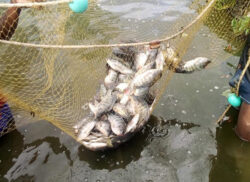
Aquaculture production in Kenya has grown steadily in recent years to more than 18,000 tonnes in 2019 and plays an increasingly important role in national fish supply. Kenya is ranked the fourth in aquaculture in Africa and endowed with a vast network of aquatic resources comprising freshwater lakes and rivers, and an extensive ocean resource base. The fisheries and aquaculture sector contributes about 0.8 per cent to the Gross Domestic Product (GDP), providing direct employment to over 500,000 people and supporting over two million people indirectly.

Current annual demand for fish feed in Kenya is estimated at 34,000 tonnes.  However, has far greater capacity for fish farming, with over 1.14 million hectares potentially available with potential a production capacity of over 11 million tonnes per year.

The Blue Economy

The Blue Economy in Kenya represents a huge opportunity and potential to achieve economic growth and generate jobs. The concept recognizes productivity of healthy freshwater and ocean ecosystems as a pathway for freshwater aquatic and maritime-based economies, and promotes the conservation, sustainable use, and management of associated marine resources.

In aquaculture, the approaches for actualising the aspirations embodied in the Blue Economy concept include Cage culture (Ocean, Lakes, Dams, and Rivers); Integrated RAS; Aquaponics/Greenhouse; Pens; breeding and restocking of commercially important indigenous species; and live fish markets

Fish Feeds

Due to the growing demand for fish and fish products, there has been a gradual shift from extensive to moderately intensive aquaculture systems, leading to an increased demand for high quality commercial fish feeds. The Government through the Kenya Marine Fisheries Institute (KMFRI) has developed fish feed standards in partnership with the Kenya Bureau of Standards (KEBS) to serve a market whose demand is estimated at 7,000 tonnes annually.

Kenya has fast-growing fish species (Nile tilapia, African catfish), extensive freshwater resources suitable for the cage, pond and tank-based aquaculture systems and its agriculture and fisheries sectors produce enough raw materials for making fish feed. Kenya also has a highly developed fish processing sector and quality assurance laboratories. Highest pond numbers and aquaculture related activities are found in Kakamega, Bungoma, Busia, Kisii, Meru, Nyeri, Kisumu, Muranga, Embu counties, among others, while relatively lower activity are noted in Kitui, Lamu and Elgeyo Marakwet.

The main cultured species in Kenya’s freshwater systems are Nile tilapia which accounts for 80 per cent of production, followed by African catfish (14 per cent). These species are found in virtually all aquatic systems and have high demand in the local and regional markets. Polyculture of Nile tilapia and African catfish is often done to control the prolific breeding of the former. Other exotic species include common carp (4 per cent), rainbow trout (2 per cent), koi carp, largemouth bass and goldfish.

Trout is temperature restricted thus only cultured at temperatures below 19°C mainly in the Mt. Kenya region. Potential indigenous candidates for aquaculture include African Carps, Lungfish and Tilapia jipe. There are great opportunities in ornamental fish culture for they can be marketed within the East African region and in Europe. The most farmed finfish species is milkfish, which accounts for about 90 per cent of production, followed by mullet contributing about 10 per cent of aquaculture production.

Juveniles of these species are found in the mangrove systems and are in high demand. Shellfish culture in coastal Kenya involves mud crabs, prawns, and artemia.

Regulatory interventions

Legislation is underway to support projects geared at pushing annual output to at least 300,000 metric tonnes of fish worth Sh100 billion annually. The Ministry of Agriculture, Livestock and Fisheries Development has developed a raft of policy, regulatory and financing incentives to accelerate transformation of the fisheries sector. Among them is the Draft Marine Fisheries Access Regulations 2021 to support local exploitation Kenya’s 200 nautical miles Exclusive Economic Zone (EEZ). The regulations will address unregulated fishing and transshipment of stock outside the country.

They will operationalise the Fishing Management and Development Act 2016, providing clarity on joint ventures between foreign investors and Kenyans at international, national or written agreements on fisheries access. They will also address some of the challenges facing Kenyan fishermen and seal loopholes used by foreign fishing vessels use to exploit the country’s rich marine resources. Efforts to transform this sub-sector have gained steam to boost food security, exports and rural livelihoods.

The Kenya Fisheries Industries Corporation and the Liwatoni Fishing Port has been gazetted. Efforts are also ongoing to improve local strain of tilapia, refurbish four fish landing sites in the coastal region, construct fish quality control laboratories and national aquaculture resource centre,

Aquaculture Value Chain

The Kenya Marine and Fisheries Research Institute (KMFRI) has developed new products to improve fish value chain in the country. The products which include minced fish, fish samosa, fish sausages, fish fingers, fish gel, smoked fish and fish fillets are being introduced to farmers as a way to add value to their fish. They were developed in collaboration with KMFRI’s research partners to promote fish farming as an income generating venture and boost production.

Through the Kenya Climate Smart Agriculture Project (KCSAP) run jointly by KMFRI and KALRO, the new products are being rolled out to farmers in Siaya, Busia, Kakamega, Lamu and Marsabit Counties. Also developed by KMFRI is a modern fish smoking kiln. Collaboration with Maseno University, Egerton University, Jomo Kenyatta University of Agriculture and Technology and University of Eldoret has led to development of new products for fish farmers.

For instance, KMFRI has partnered with JKUAT to produce insect-based feeds which are nutritious for fish and will ensure that farmers get higher yields. KMFRI is also supplying fish farmers with high quality breeds and fingerlings.

Lifebyte

By Florence Kinyua and Bernard Munyao, KNA

Jeremiah Makimi ventured into fish rearing two years ago and has been making a fortune out of it. Speaking to KNA in his home in Sagana, he admits it was not easy starting out fish farming because aquaculture is not popular in Central Kenya but with resilience and a few false starts, he has managed to carve a niche for himself. “I started with constructing two ponds in our half acre piece of land, which I stocked with 2000 fingerlings of catfish in each pond,” said Makimi

He notes that despite there being adequate water masses in Central, fish farming remains unexploited as many shy away from the venture due to high start-up capital as Makimi elaborates.“I constructed two ponds, each measuring 8m by 10m and purchased fish nets to keep predators like birds and other animals away,” he notes. The Construction and stocking with fingerlings cost the Makimi close to Kshs 200,000. “I sourced 4000 fingerlings from a fellow farmer at a cost of KShs 10 per fingerling,” observed Makimi.

The fish farmer adds that with time they diversified to other species of fish and currently they have five ponds each containing different species of fish. “I rear tilapia, catfish and other ornamental fish that are doing very well in this cool climatic condition” he pointed out. Normally, the fingerlings are stocked at three weeks and are mature to sell at 8 months. He says adding that farmers need to be careful and know when the fish mature because fish eat each other. The fish are fed twice a day, with worms, waste feeds and artificial feeds. Together with his wife Jane, Makimi runs an exclusive fish restaurant that serves local community.

In addition to the restaurant, Makimi sells his fish to suppliers and other buyers in Kirinyaga and Murang’a. “I make a profit of Kshs 100 per kilo of fish and per harvest I’m able to make a profit of Kshs 40,000 and I can harvest up to 500 Kgs,” he expounded. He mentors other farmers who want to venture into fish farming and together they have formed a group of 40 members. “I have offered mentorship to around 40 farmers who have all started their own fishponds” confirms Makimi adding that aquaculture is profitable if one has his own land and fresh source of water. “I would encourage more people to venture into it, as there is a lot of unexploited potential since the demand is high”. However, like any other venture, as Makimi says, fish farming has its fair share of challenges. He observes that disposal of fish water due to pollution is one of the challenges farmers have to grapple with. He also notes that sometimes there is shortage of water, and that the feeds too are expensive.

Warehousing and cold chain sites

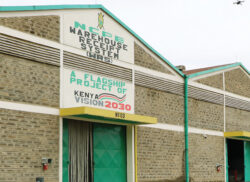
One of the warehouses where the Warehouse Receipt System is under implementation. Under the Warehouse Receipt System, the farmer will deposits his harvest in a certified warehouse and is issued with a document of title called a Warehouse Receipt as proof of ownership. This allows the farmer to survey the market and sell at the best market rates and at the same time, the farmer can use the receipt as collateral for a loan from participating financial institutions to offset pressing monetary needs or prepare for the next season.

Around 14 per cent of produce worldwide is lost after harvest on farms and at the transport, storage, processing and wholesale stages, according to the Food and Agriculture Organization (FAO). This amounts to more than US$ 400 billion a year. FAO estimates that over 40 percent of food in Sub-Saharan Africa perishes before it reaches a consumer, often referred to as food loss. For Fresh Produce, this can be as high as 60 percent in Sub-Saharan Africa. About 90 percent of Kenya’s agricultural produce comes from smallholders, who don’t have the kind of cold storage solutions available to large-scale producers.

The most affected are fruits and vegetables. It is estimated that 40 per cent to 60 per cent of fruits and vegetables perish along the supply chain due to a lack of warehousing and cold chain solutions in Kenya. Most crops are only seasonally available with price variations between peak harvest and low season reaching up to 500 per cent under normal conditions.

UN Secretary-General António Guterres last year described food loss and waste as an “ethical outrage.” “In a world with enough food to feed all people, everywhere, 690 million people continue to go hungry and 3 billion cannot afford a healthy diet,” he said. Consolidated warehousing for commodities and agriculture in the value-chain reduces wastage. Modern warehouses with security and pest and temperature control could radically reduce this loss.

Warehouse Receipt System

The introduction of the Warehouse Receipt System (WRS) by the Government has been nothing short of revolutionary. First introduced to reduce post-harvest losses for cereal farmers by the National Cereals and Produce Board, the WRS now covers coffee and tea as well. WRS is a process where producers deposit their commodities in certified warehouses and are issued with a Warehouse Receipt. Its impact is massive. WRS is already credited with:

  • Reducing post-harvest losses: enabling small scale farmers to participate in a modern and efficient market with standard quality and weights.
  • Increasing access to finance: encouraging increased lending to the Agricultural sector by providing alternative collateral (commodity) and mitigating risk to the banks, especially for the youth and women who do not have access to traditional collaterals such as Title deeds and logbooks
  • Quantity and quality: enabling small scale farmers to participate in a modern and efficient market with standard quality and weight
  • Promotion of aggregation of produce by small scale farmers: enabling access to large traders, Agro-processors and value addition.
  • Creating flexibility in the sale process: enabling farmers to align the sale of their commodities to favourable pricing
  • Reducing price volatility and improving liquidity as the first step towards a commodity exchange and improved price discovery/stable prices
  • Eliminating the gap between men, women and the youth in access to agricultural resources such as Loans.
  • Access to loans for women and youth

Phase 1 roll-out of the Warehouse Receipt System in Kenya covers five NCPB Certified Warehouses in Kitale, Eldoret, Nakuru, Nairobi and Meru. The Agriculture Food Authority (AFA) directorate is tasked with carrying out inspection and certification process of NCPB stores under the Food Crops Regulations that were drafted pursuant to Section 40 of the Crops Act 2013. The requirements for warehouse standard for food storage uses a check list that has 122 check boxes as guided by Kenya standards, 2657 /2016 on warehousing and storage of bulk commodities.

Several parastatals, including the Kenya National Trading Corporation (KNTC) and New Kenya Planters Cooperative Union (KPCU) are participants in the WRS. Under the new reforms private sector is allowed to participate in the WRS as NCPB will initially have to cede at least 25 per cent of its storage capacity across the country through competitive commercial leasing. The Government has also lifted restrictions on the use of customs bonded warehouses in the country. These are warehouses licensed by KRA for the storage of imported goods pending the payment of duties.

According to the Kenya Association of Manufacturers (KAM) the country does not have the capacity to produce a wide range of imported products including lubricants, alcoholic beverages and building and construction materials. Warehousing ensures continuous production as raw materials are kept within the country rather than imported when required. It makes it possible for businesses to establish highly efficient supply chains, giving them a competitive advantage.

As these businesses grow, they create economic opportunities by creating jobs (directly and indirectly). For the companies that opt for large scale production and bulk supply, warehousing is a must. Warehousing help companies ensure quick supply of goods in demand.

Team Kenya tops Africa, 19th globally

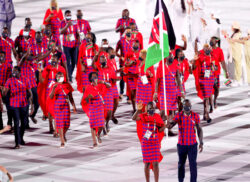
President Uhuru Kenyatta with the Kenya official Tokyo 2020 Olympic games team during the unveiling of the jersey, and National flag handover.

Once again, athletics provided all of Team Kenya’s medals at the 2020 Tokyo Olympics as other disciplines returned home empty-handed. The 2020 Tokyo Olympic and Paralympic Games took place in Japan amid a crippling COVID-19 pandemic, occasioning a year’s delay in the Games. Instead, the Games took place from July 23 to August 8, 2021.

The Paralympics, the event designed for athletes with visual, physical and intellectual challenges, took place in Tokyo from August 24 to September 5, 2021. The events retained the 2020 tag despite the one-year delay.

Participating for the 15th time at the quadrennial event since its debut in 1956, Kenya was among 205 nations, plus a Refugee team, that took part in the Games.

Team Kenya Paralympics debuted at the Games in 1972 in Heildelberg, Germany, and the 2020 edition was the country’s 12th appearance in Tokyo, where 163 nations competed.

Overview of Team Kenya

The 2020 Tokyo Olympic Games were Kenya’s ninth straight appearance since boycotting the 1976 Montreal and the 1980 Moscow Games. Kenya sent a total of 85 athletes in seven disciplines, as they returned to the city where the country won its first ever Olympic medal, a bronze, in 800m at the 1964 Olympics through Wilson Kiprugut Chumo.

Kenya took part in seven disciplines, with the Beach Volleyball duo of Gaudencia Makokha and Brackcides Khadambi Agala being the newest of the Team.

It was a nostalgic return for Team Kenya, but not an entirely happy one – at least not at the beginning.

The women indoor volleyball team, beach volleyball, Rugby Sevens men and women, and the two boxers took a beating in the early days of the competition.

All eyes were on the Athletics contingent, considered Team Kenya’s mainstay. The 2016 Rio Olympics was by then the most successful outing for Kenya (6 gold, 6 silver, 1 bronze) and despite the COVID-19 pandemic, Kenyans retained the confidence of another superlative performance.

But they were in for a shock when Team Kenya relinquished the 1,500m (men) gold and, for the first time ever, the other race made in Kenya, by Kenyans, for Kenyans – the men’s 3,000m steeplechase.

The Athletics team, however, clawed back their pride by winning four gold, four silver and two bronze medals under stifling heat and humidity in the Tokyo summer conditions.

The medals saw the team finish a respectable 19th overall position at the Games and, of course, the top in Africa.

Gold Medals in focus

Gold: Emmanuel Korir (800m men)

With the king of the two-lap race, David Rudisha, blighted by injuries since winning the London 2012 competition in record time (1:40.91), and Rio 2016, Kenyans had doubts as the team headed to Tokyo with Emmanuel Korir, Ferguson Rotich and Michael Saruni.

Korir, a trainee of the 1988 Seoul Olympics 800m hero, had the country on tenterhooks as he hung on at the final bend for a precious gold in 1:45.06, with Rotich (1:45.23) engaging the afterburners for an unlikely 1-2 finish.

Gold: Faith Chepngetich (1,500m women)

The headlines toyed with her first name as the country banked on the indefatigable Faith. Despite her fighting spirit, there was talk of a Dutch threat posed by Sifan Hassan and England’s Laura Muir. Chepngetich, however, took them as they came. In the final, she outran both and set an Olympic record of 3:53.11.

Marathon gold

For the second successive Olympics, Kenya won both medals in the most punishing of races.

Eliud Kipchoge and Jemimah Sumgong brought home gold from Rio de Janeiro, Brazil. Tokyo 2020 welcomed two of the world’s record holders, Eliud Kipchoge (2:01:39 set in 2018) and Brigid Kosgei (2:14:04 set in 2019) in a race staged in Sapporo, 831km north of the capital. Due to the heat in Tokyo that was hovering above 30°C, organisers settled for Sapporo as it offered 2°C to 3°C lower advantage. Both races started at 27°C on each day; August 7, 2021 (women) and August 8, 2021 (men). The Kenyans put up an incredible show.

Gold: Peres Jepchirchir (women marathon)

The Kenyan girls defied the harsh weather, such that by the 30km point of the 42.195km race, it was clear Team Kenya meant business. Ruth Chepngetich, who had sacrificed herself by setting the pace, fell off by the 25km mark, leaving Jepchirchir and Kosgei in a good position to deliver the goods. Indeed, Jepchirchir (2:27:20) guided home Kosgei (2:27:36) for gold and silver.

Eliud Kipchoge (Men marathon)

There had been a chink in the armour of marathon king Eliud Kipchoge, having been beaten for the second time in his career, at the 2020 London Marathon. Ethiopian Shura Kitata won in London on October 4, 2020 – a win that yanked the door open for the Doubting Thomases.

Kitata led a battery of other road hogs to Sapporo for a showdown that pundits said would be the ‘ultimate test’ for Kipchoge. Shock on them! Kipchoge put up a majestic performance, finishing the race with a sprint in the stifling Sapporo heat and humidity, in 2:08:38. His compatriots, Lawrence Cherono (2:10:02) finished fourth while injured Amos Kipruto dropped out. The gold was safe and back home.

Honourable mentions

Silver medalists

  • Ferguson Rotich (800m men)
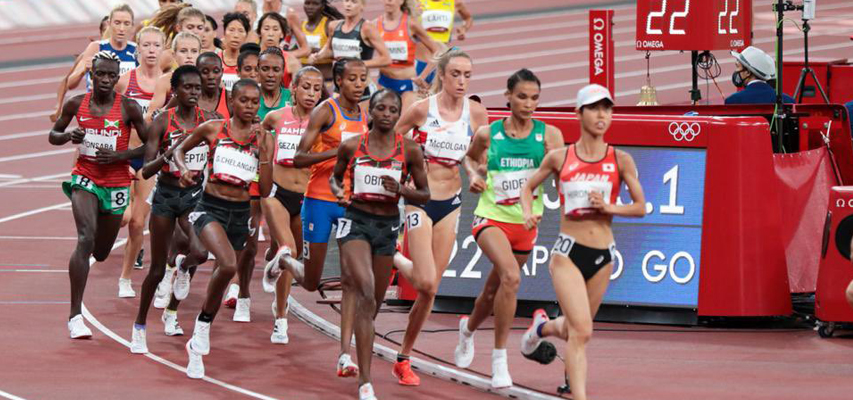
  • Hellen Obiri (5,000m women)
  • Brigid Kosgei (women marathon)
  • Timothy Cheruiyot (1,500m men)

Bronze medalists

  • Benjamin Kigen (3,000m steeplechase; men)
  • Hyvin Kiyeng (3,000m steeplechase; women)

Boxing 

Kenya’s last two medals in boxing came in the 1988 Seoul Olympics; Robert Wangila’s gold in Welterweight and Chris Sande’s bronze in Middleweight during the reign of the ‘Hit Squad’.

And so, at the 2020 Tokyo Games, the weight of expectation was on two male boxers; Nick Okoth (Featherweight), Elly Ajowi Ochola (Heavyweight) and two women – Christine Ongare (Flyweight) and Elizabeth Akinyi (Welterweight).

Nick Okoth lost in the round of 32 to Mongolia’s Tsendbaatar Erdenebatyn while Ajowi fell to Cuba’s Julio Ceasar la Cruz Peraza in the round of 16, having got a bye in the round of 32. The Philippine’s Irish Magno eliminated Ongare at the round of 32 while Akinyi lost to Mozambique’s Alcinda Helena Panguana in the round of 16 after a bye in the round of 32.

Rugby Sevens (men and women)

Kenya returned to the Olympics for a second straight time, having competed at the inaugural edition at Rio in 2016. Any hope of banishing the ghosts were quickly eroded after Shujaa fell 14-5 and later 19-14 to the US. The two defeats took the wind out of the sails of the Kenyans, and another loss, 12-7 to Ireland, confirmed the inevitable.

Wins over Japan (21-7) and Ireland (22-0) in the ranking matches proved only academic as Kenya’s challenge collapsed under the Tokyo heat. Kenya finished ninth out 12 countries.

Men’s squad

The Kenya Sevens men team, Shujaa: Andrew Amonde (KCB, captain) Alvin Otieno (Homeboyz), Vincent Onyala (KCB), Herman Humwa (Kenya Harlequin), Collins Injera (Mwamba), Daniel Taabu (Mwamba), Willy Ambaka (Kenya Harlequin), Johnstone Olindi (KCB), Eden Agero (Kenya Harlequin), Jeffrey Oluoch (Homeboyz), Nelson Oyoo (Top Fry, Nakuru), Jacob Ojee (KCB), and Billy Odhiambo (Mwamba).

Officials: Innocent Simiyu (coach), Anthony Muchiri (assistant coach), Lamch Francis (medic), Erick Ogweno (manager).

Try scorers – Two tries

  • Collins Injera
  • Jeff Oluoch
  • One try
  • Willy Ambaka
  • Andrew Amonde
  • Jacob Ojee
  • Johnstone Olindi
  • Vincent Onyala
  • Alvin Otieno
  • Daniel Taabu

Kenya Sevens women team, Lionesses

Tokyo 2020 was the Lionesses’ second appearance at the Games, the first being in the Rio 2016 edition. Pooled alongside illustrious nations, the Lionesses proved easy game to New Zealand, Russia Olympic Committee team and Great Britain.

The Lionesses, however, claimed the host’s scalps 21-17 in the ranking match but were pushed back by Canada 24-10 to finish 10.

Lionesses Olympic Squad: Philadelphia Orlando (Northern Suburbs captain), Sheila Chajira (Homeboyz), Stella Wafula (Impala Saracens), Christabel Lindo (Impala Saracens), Leah Wambui (Homeboyz), Judith Auma Okumu (Homeboyz), Vivian Akumu (Top Fry, Nakuru), Sarah Oluche Ndunde (Mwamba), Grace Adhiambo Okulu (Top Fry, Nakuru), Cynthia Camilla Atieno (Homeboyz), Janet Okello (Mwamba), Sinaida Aura Omondi (Northern Suburbs), Diana Awino Ochieng (Impala).

Officials: Felix Oloo (coach), Samuel Njogu (strength and conditioning coach), Ben Mahinda (medic), Camilyne Oyuayo (manager).

Try Scorers – 3 tries

  • Janet Okello

1 try

  • Christabel Lindo
  • Grace Okulu
  • Sinaida Omondi
  • Camilla Atieno
  • Diana Ochieng’

Final standings

  • Gold: New Zealand
  • Silver:  France
  • Bronze: Fiji
  • Great Britain
  • Australia
  • USA
  • China
  • Russia Olympic Committee
  • Canada
  • Kenya
  • Brazil
  • Japan

Swimming                          

Kenya was represented by two swimmers; Danilo Rosafio and Emily Muteti.

Rosafio competed in the men’s 100 metre freestyle. Although he finished first in Heat 2, his time of 52.54 could only place him 56th overall out of 71.

Muteti – The Mombasa-born swimmer, represented Kenya in the women’s 50 metre freestyle event. With 16 top performers out of 83 advancing to the round of 16, Muteti’s 26.31 seconds for fourth position in Heat 6 saw her finish 43rd overall.

Beach Volleyball’s baptism of fire

The Kenya Beach Volleyball team debuted at the Olympics. As is usual for most debutants, Kenya’s pair of Gaudencia Makokha and Brackcides Agala found themselves in the deep end of the pool.

The duo lost all their matches; 2-0 (21-15, 21-9) to the Brazilian pair of Anna Patricia Ramos Silva and Rebecca Silva. They went down 2-0 (21-8, 21-6) to USA’s Sarah Sponcil and Kelly Claes. And another defeat, 2-0 (6–21, 14–21), to Latvia’s Anastasija Kravčenoka and Tina Graudiņa. But it was no shame for the Kenyans as USA eventually won gold.

Taekwondo       

The sole Kenyan representative, Faith Ogalo, had to go through the repechage to earn passage to round one proper in the Women’s 67kg.

On July 27, 2021 Ogalo lost both fights (15-7 against Poland’s Aleksandra Kowalczuk; and 13-0 against Serbia’s Milica Mandić).

Tokyo 2020 Paralympics review

Team Kenya returned home with a bruised nose

Overview

The Team Kenya Paralympics arrived in Tokyo hoping for a decent outing amid concerns of inadequate preparedness, given the COVID-19 pandemic that made it difficult for athletes with special needs to train.

Nevertheless, Kenya sent nine athletes; seven for track events and one each in Para-rowing and Powerlifting. The visually impaired athletes, as a standard procedure, had their guides.

Kenya arrived in Tokyo with five records under its belt, but after grueling action that ended on September 5, 2021, Samwel Mushai’s record in 1,500m T11 had been demolished by a Brazilian.

Team Kenya Paralympic athletes and guides:

  1. Eric Kiptoo Sang (Guide, David Korir) – 1,500m (T11)
  2. Wilson Bii (Guide, Robert Tarus) – 1,500m T11, 5,000m (T11)
  3. Rodgers Kiprop (Guide, Alpha Malinga) – 5,000m (T11)
  4. Felix Kipruto – 1,500m (T46)
  5. Mary Waithera Njoroge (Guide, Bernard Korir) – 1,500m (T11)
  6. Nelly Nasimiyu Munialo (Guide, Eric Kirui) – 1,500 (T13)
  7. Nancy Chelangat Koech (Geoffrey Malel) – 1,500m (T11)

Para-rowing (Single Sculls – PR1W1x): Asiya Sururu Mohamed

Asiya Sururu Mohamed made history as Kenya’s first ever woman to participate in the Paralympics water events as she took part in the Women’s Single Sculls. Predictably, the going proved tough but not without precious lessons learnt. The Kenyan double amputee was placed 12th overall, registering an impressive 13:14.26 time on day two of the competition. Norway’s World Record holder Birgit Skarstein won gold.

Asiya’s timings

Day One:    13:45.50

Repechage 1: 13:14.26

Repechage 2: 14:27.48 minutes

*Repechage: (in rowing and other sports) is a contest where the best-placed of those who failed to win heats compete for a place in the final.

Powerlifting – Hellen Wawira Kariuki

Hellen Wawira Kariuki was the first Kenyan in action at the 2020 Tokyo Paralympics Games on August 26, 2021.

In a quality field that yielded a World Record via China’s Lingling Guo, who lifted 108kg, Wawira did not desecrate the Kenyan flag as she was placed fifth with a flawless lifting of up to 93kg. Indonesia’s

Widiasih Ni Nengah lifted 98kg for silver while Sarahy Clara Monasterio Fuentes of Venezuela (97kg) settled for bronze.

Final classification: Women’s 41kg Powerlifting

  1. Lingling Guo (China) Best lift: 108kg (gold).
  2. Ni Nengah Widiasih (Indonesia) 98kg (silver).
  3. Clara Sarahy Fuentes Monasterio (Ven) 97kg (bronze).
  4. Zoe Newson (Great Britain) 94kg.
  5. Hellen Wawira Kariuki (Kenya) 93kg.
  6. Cristina Poblador Granados (Colombia) 92kg.
  7. Lara Aparecida de Lima (Brazil) 88kg.
  8. Moura Baddour (Syria) 82kg.
  9. Maryna Kopiika (Ukraine) (no lift, three attempts).
  10. Leidy Rodriguez (Cuba) (no lift, three attempts).

Athletics

Courtesy:Olympics

Kenya’s only medal, a bronze, came through Nancy Chelangat Koech in the 1,500m T11 final.

It was the second time Kenya had won a single medal in the event, the first being in the inaugural edition in Heidelberg, Germany, in 1972, when John Britton won gold in swimming.

Precious bronze for Kenya

1,500m T11 (athletes with complete or severe visual impairment)

Ran under hot and humid conditions at the Tokyo Olympic Stadium, Kenya’s representatives battled stifling heat, only for Nancy Chelangat Koech, guided by Geoffrey Kiplangat, to make it to the final. Despite Mary Waithera Njoroge, guided by Bernard Korir, finishing third in Heat 1 with a personal best of 4:52.54, she did not make it to the final. Chelangat, who had finished fourth in Heat 2, reached the final, thanks to a faster time of 4:51.68.

Chelangat, together with her elder brother Kiplangat, would deliver Kenya’s only medal –  a bronze – in a season best of 4:45.58.

1,500m T11 (athletes with complete or severe visual impairment)

Eric Kiptoo Sang (Guide, David Korir) and Wilson Bii (Guide, Robert Tarus) found themselves without the company of record holder Samwel Mushai. Wilson Bii and his guide were disqualified for violating rule 6.15.4b              relating to the minimum and maximum length of the guiding loop that must be observed and respected at all times during the races for Track and Road Events. Sang (4:32.73) proceeded to the final after a successful appeal, following a crash involving Brazilian guide Lutimar Paes Abreu for athlete Julio Cesar dos Santos Agripino. The crash, however, cost Sang his guide Korir, who suffered cuts during the fall. Replacement of the guide in the final impacted Sang’s title challenge as he finished sixth in 4:21.53, with Brazilian Yeltsin Jacques carting away the gold and Mushai’s World Record as he re-set it at 3:57.60.

1,500m T46 (people with a single, below or above the elbow, amputation)

Felix Kipruto was the only entrant to this event. His class does not require a guide as his impairment is physical after he fractured his right hand in three places at the age of 11. Kipruto’s campaign ended despite setting a personal best of 3:59.98 in the heats.

5000m T11 (Final) (athletes with complete or severe visual impairment)

Wilson Bii, guided by Robert Tarus, had hoped to improve on the bronze medal he won at Rio 2016, but those dreams turned into a nightmare under the Tokyo heat as he finished sixth in 17:31.73. Debutante Rodgers Kiprop, guided by Alpha Malinga, looked to be in the right frame to challenge for honours but wilted to finish fourth in a personal best time of 15:27.06.

1,500m T12 (athletes with a higher visual acuity than T11 athletes)

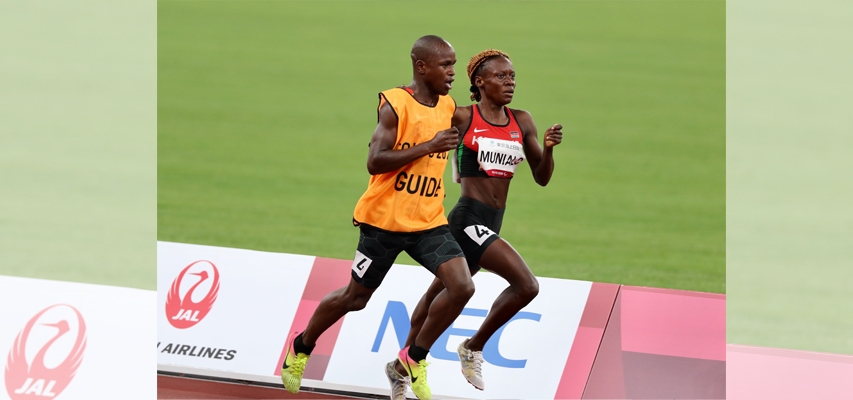
Nelly Nasimiyu Munialo was Kenya’s only representative in this category. Guided by Erick Kirui, she did not make the final after she was disqualified for infringing rule 7.9.3 of Paralympics regulations, in which the athlete and the accompanying guide-runner shall retain the tether attachment from start to finish.

Kenya’s performance at the Paralympics

Nelly Munialo (right) and guide Erick Kirui participate in the paralympics games 2021. A contingent of 54 athletes and officials represented Kenya in the Paralympic games in Tokyo. Kenya first participated in the Paralympic games in 1972 and this will be the 22nd time the country is joining other countries in the competition. /Olympic
  • 1972 (Heidelberg, West Germany): One gold, no silver, no bronze;
  • 1980 (Arnheim, Netherlands): 1-2-0;
  • 1984 (Stoke Mandeville, Great Britain) 1-1-1;
  • 1988 (Seoul) 0-4-1;
  • 1992 (Barcelona) 1-0-1;
  • 1996 (Atlanta) 1-1-0;
  • 2000 (Sydney) 1-1-2;
  • 2004 (Athens) 3-1-3;
  • 2008 (Beijing) 5-3-1;
  • 2012 (London) 2-2-2;
  • 2016 (Rio de Janeiro) 3-1-2;
  • 2021 (Tokyo) 0-0-1.


Big four agenda projects

Projects under the five-year MTP III are clustered under four main pillars, hence the term Big 4. These are Manufacturing, Food Security and Nutrition, Universal Health Coverage – Affordable Healthcare for All – and Affordable Housing for both low and middle income earners.

Manufacturing

Ports, Roads and Rails

Construction of the first three berths of the second commercial port in Lamu is now complete with one container yard ready for operations. The port is set to create job opportunities linked to the port operations both directly and indirectly.

The LAPSSET Corridor Programme

East Africa’s largest and most ambitious infrastructure project, brings together Kenya, Ethiopia and South Sudan. It has seven key initiatives with a total cost of over US $13bn.

Arguably Kenya’s most ambitious venture, the Ksh2 trillion Lamu Port-South Sudan-Ethiopia-Transport (LAPPSET) Corridor project will boost economic activities and double the country’s GDP.

Key components include Lamu Port, Lamu-Ethiopia-South Sudan highway, Lamu-Juba-Addis Ababa railway, an oil refinery and a 2,240km pipeline linking oil fields in South Sudan to the refinery at Lamu Port.

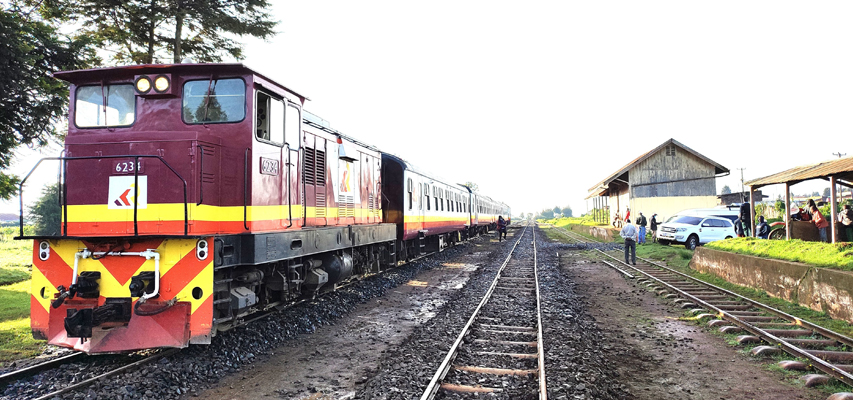
Kenya Standard Gauge Railway

The 969 km standard gauge railway from Mombasa to Malaba is among the largest and most ambitious transport infrastructure projects in Africa.

Phase I of the project, which is 472km from Mombasa to Nairobi, is complete as is Phase 2A from Nairobi to Naivasha (120km). The section to Kisumu is still pending.

Mombasa Port Expansion

It includes Phase II of the second container terminal at the Mombasa Port.

Nairobi Expressway

Proper planning for future infrastructure development has proven key in the construction of Kenya’s first Expressway. Connecting the Northern and Southern districts of Nairobi, the 18 kilometre, two-way, four-lane road is expected to not only ease traffic but also boost business in the city.

Decongestion of the Northern Corridor, running through the centre of Nairobi, is critical to the city‘s future. Construction is underway on the 27km highway to ease costly traffic congestion in Nairobi. China Road and Bridge Corporation (CRBC) is the contractor and the Expressway runs from Mlolongo to JKIA and through the city centre, to James Gichuru road junction in Westlands. CRBC is building the road on a public-private partnership (PPP) and a concession period of 30 years that includes three years of construction.

Standard Gauge Railway

This iconic multi-modal urban development will be located inside the 200-acre prime property that currently serves as the Nairobi Railway Station as part of the Nairobi Integrated Urban Development Plan (NIUPLAN) for expanding the city’s Central Business District.

The Kenya Railways (KR) has partnered with the Nairobi City County Government (NCCG) and the Ministry of Transport, Infrastructure, Housing and Urban Development, in the project.

This exciting initiative will be implemented in three phases. The first stage will see the construction of meetings, incentives, conferences, and exhibitions (MICE) facilities along Bunyala Road in Nairobi.

Phase two will include construction of an economic zone comprising hi-tech industries and small and medium enterprises.

The final phase is the building of an affordable housing complex that will include a school, park, and affordable housing units. The Railway City will be integrated to the Nairobi Expressway, Bus Rapid Transit (BRT) systems and the Nairobi Commuter Rail Service.

A special purpose vehicle to spearhead the project called Railway City Development Authority (RCDA) has been created to spearhead the initiative, including identifying anchor projects and investors.

Kisumu Port Rehabilitation

As part of the Kisumu port facility rehabilitation that includes an Oil jetty, Kenya Pipeline Corporation has installed 14 tanks with a capacity of 70 million liters of petroleum products, making it larger than the Kisumu and Eldoret depots. The jetty is designed to enable seamless availability of petroleum products to neighboring countries.

As per the National Economic Survey 2020, the refurbished Port of Kisumu processed 62 percent more cargo in 2019, largely due to increased trade with neighbouring East African Community countries and better efficiency and a surge in trade — new statistics show.

This has established Kisumu port as the hub for inland EA trade in the Great Lakes Region.

Not only has the volume of cargo handled at the revamped port increased, but so has the number of vessels visiting the port, up by 116 percent in 2019.

Energy

Kipevu Oil Terminal

The facility, whose construction is underway in Mombasa, will be ready by August next year — enabling bigger volumes of fuel products to move in and out of Kenya.

On completion, the New Kipevu Oil Terminal will have four berths capable of handling the importation and exportation of crude oil, heavy fuel oil, aviation fuel, petrol, and diesel.

Technology

Konza Technopolis

H.E Uhuru Kenyatta during the official opening of the Konza Technopolis Development Authority headquarters.

Konza Technology City is a smart city project 64km south of the capital Nairobi, on 2,000 hectares (5,000 acres) of land, in Machakos County.

Part of Kenya’s Vision 2030 blueprint, it is projected to create about 17,000 direct high-value jobs, and 68,000 indirect jobs, once completed.

The project is modelled on the US Silicon Valley, hence the moniker “African Silicon Savanna”.

It targets business process outsourcing, software development, data centres, disaster recovery centres, call centres, light manufacturing industries, and research institutions. The project’s cost is US$ 14.5 billion.

Designed as a world-class technology hub, Konza is projected to host a vibrant mix of businesses, workers, residents, and urban amenities.

The plan for Konza includes urban amenities, friendly and tech-ready neighborhoods, access to parks and recreation, transit-oriented development and varied retail and restaurants options.

It will host data centers, technology and life science facilities, commercial office space, hotels, convention centers, educational institutions, and community support services.

Food Security and Nutrition

Galana/Kulalu Project

Hosted by two counties, Kilifi and Tana River, the project seeks to bring down the price of Kenya’s staple food (maize) and boost local production of sugar, fruits, beef, dairy products, fish, poultry and honey.

This involves development of physical infrastructure for viable and economic utilisation of the natural resources available within, or accessible to the area making up the Galana and Kulalu Ranches, including but not limited to water storage, water conveyance and distribution, irrigation, livestock production, aquaculture, road network, land development, eco-tourism, among others.

The project covers 1.75 million acres of public land on the lower River Athi/Galana/Sabaki basin for investments in irrigation, livestock and fisheries enterprises with related social infrastructure such as production storage, processing and marketing equipment. There is a land-use plan to guide sustainable utilisation of natural resources. The main land uses are urban and agriculture. Despite some “teething problems” the project remains on course.

Development of Lake Turkana Fishery and Post- Harvest Operations

The project will increase aquaculture productivity and incomes of aquaculture farmers and other stakeholders.

It will be implemented in schools, mariculture development along the Kenyan coastline, cage culture systems in fish farms and water bodies, and model pilot Recirculation Aquaculture System (RAS).

The project will also entail construction and development of an International Nile Perch Research Centre at Kabonyo in Kisumu for research on reproduction, nutrition and genetic variation factors of Nile perch for future restocking of Lake Victoria.

Lower Turkwel Irrigation Project

It was conceived as a multi-purpose initiative to develop dams to store water for hydropower generation, develop irrigation infrastructure for 30,000Ha for sugarcane production and for food production in the downstream areas, consumption for both households and livestock, environmental conservation, fisheries and tourist development.

To date, a dam has been developed with a capacity of 1.6 billion m3 of water and is currently being used by KenGen to produce 106MW of electricity that is fed into the national grid.

Integrated Fish Resources Development Project

Coast Development Authority (CDA) aims to improve the livelihoods of the local fishermen and the community on the coastline of Kenya through the Integrated Fish Resources Development Project.

This project intends to implement various components in an integrated manner, including rehabilitation of fish habitat, fish farming and breeding, fish harvesting, fish processing and value addition, marketing and market linkages and community support.

Koin-Soru Dam

Feasibility study is ready and the designs finalised. The process of public participation is complete but negotiations on compensation for people to be displaced by the dam are ongoing.

It will end perennial flooding caused by River Nyando downstream and provide water for domestic use and irrigation, as well as 2MW of electricity. It will be located 5km upstream of River Nyando from Muhoroni town on 2,500 acres of land.

Thwake Multipurpose Water Development Programme

As a key contributor to the Big 4 Agenda and a Vision 2030 flagship project, Thwake Multipurpose Water Development Programme will ensure access to safe drinking water, healthy meal preparation, proper sanitation, and health and industrialisation for the residents of Makueni, Kitui, and parts of Machakos.

The programme comprises a multi-purpose dam for water supply, hydropower generation and irrigation development. In Phase 1, the programme will increase water security by providing 681 million cubic metres (MCM) of water storage for human consumption, power generation and upstream and downstream irrigation and conservation.

The target population will benefit from an abundant supply of potable water, which will lead to improved health and spur economic development throughout the area and in Konza City.

Construction is underway on the Ksh82 billion dam on the border of Kitui and Makueni. Jointly funded by the Government of Kenya and the African Development Bank (AfDB), the project will be implemented in four phases at a cost of Ksh81.89 billion.

Universal Health Coverage — Affordable Healthcare for All

Kenyatta National Hospital multidisciplinary team of medical specialists participating in a urological medical camp in Kitui County. The camp carried out in four hospitals saw at least 109 patients undergo a prostate enlargement a minimally invasive surgery (urethroplasty). The doctors as well undertook surgeries relating to urethral blockage on 73 others. These surgeries under normal circumstances cost Sh300,000 but the annual medical camp under the Kenya Association of Urological Surgeons (KAUS) umbrella body through their CSR initiative carried them out for free.

Piloting of UHC began in 2018 in four counties, with a programme that eased access to health services for millions of people.

Since then, over 200 community health units were created, with 7,700 community health volunteers and over 700 health workers recruited.

The first year of the pilot phase saw over 1.6 million more hospital visits recorded.

The abolition of all fees at local and secondary level [county referral] health facilities widely expanded access to health services in the four pilot counties that were selected because of a high prevalence of communicable and noncommunicable diseases, high population density, high maternal mortality, and high incidence of road traffic injuries.

The Government is now working to accelerate staff recruitment, develop better links between local and higher-level health facilities, improve funding delivery timings, and supply of medical commodities as well as coordination and management.

The focus is also on reforming the National Hospital Insurance Fund (NHIF), establish a mandatory universal health coverage scheme, adopt an essential package of health services, and provide health coverage for 1 million low-income households to be biometrically registered.

Investments during the first phase of the UHC have helped in the COVID-19 response, and more health personnel have been hired to help curb the spread of the epidemic, which has severely strained health systems across the region, and disrupted the provision of essential health services.

Affordable Housing

The State Department for Housing and Urban Development lists several projects on its website under the Affordable Housing Programme (AHP).

Park Road is the first development promoted by Government under the Affordable Housing Programme. This integrated human settlement project is located in Ngara area of the City of Nairobi, and consists of 1,370 housing units.

Mavoko Sustainable Housing Programme will see the provision of 463 units and includes various social amenities.

Further project details are available from the National Housing Corporation, and units have been available for selection since mid-2020.

Kibera Soweto East Zone B will see redevelopment with the construction of residential units of one, two and three bedrooms in highrise blocks of 12 floors. The Government through the Slum Upgrading Department is in the process of planning for the redevelopment of Kibera Soweto East Zone ‘B’.

The department has targeted to develop 3,000 housing units and other social amenities in the 3.5 ha piece of land demarcated as Zone ‘B’.

At Stoni Athi View, off the Nairobi-Mombasa Highway, the National Housing Corporation (NHC) has built economy-block rental units. The project is located a kilometre from the Kenya Meat Commission factory, 20km from Jomo Kenyatta International Airport (JKIA), 3km from the Export Processing Zone (EPZ), and multiple manufacturing facilities.

In the same site, NHC has built spacious four-bedroom, semi-detached maisonettes in an excellently planned gated community with a safe boundary wall, well landscaped greenery and open play courts for children and a panoramic view of Stoni Athi Dam and River Stoni Athi.

In Nairobi, the Starehe Affordable Housing Project is approximately 2.5km from the Nairobi CBD, in the eastern zone of the county. It is envisioned as a mixed-use development with social, common and housing amenities, and a development potential of 3,000 units of various types.

Another initiative is the Pangani Affordable Housing Project initiated by the Nairobi City County Government in partnership with Tecnofin Kenya Limited to renew and re- create Pangani Estate.

It is the premiere PPP (Public Private Partnership) Venture under the Affordable Housing Pillar of the Big 4 Agenda, dubbed Boma Yangu.

Construction is currently ongoing. When complete, the project will have 1,562 units with mixed elements of amenities in the commercial space to cater to residents.

Kitui County Affordable Housing Project, Kalawa Road, is a Public Private Partnership (PPP) between the Kitui County Government and Tecnofin Kenya Ltd, a local real estate company.

It is located along Kalawa Road, opposite WARMA offices, right within Kitui town.

The project is in line with President Kenyatta’s Big 4 agenda; Pillar 4 on Affordable Housing.

Finally, in Kitui County, is the Kalawa Housing Programme that will provide comfortable, modern housing with an unobstructed view of Nzambani Rock, flexible payment terms, proximity to Kitui town and other social amenities such as schools and hospitals.

The project has a planned total of 509 units.


Foreword by President Uhuru Kenyatta

This is an abridged version of President Uhuru Kenyatta’s speech marking Kenya’s 58th Madaraka Day in Kisumu. The speech captures the full spirit and vision of the Big 4 Agenda and Kenya’s Vision 2030 social and economic development blueprint. The choice of Kisumu to host Madaraka Day this year was intertwined with our national heritage, for there cannot be a better place to celebrate our liberation struggle and ponder the future of our self-rule than Kisumu City.

Kisumu is not only the historical hub of East African Co-operation; it is also the intellectual incubator of some of the leading ideas behind our liberation movement. The national motto of “Harambee”, even though an import from India, was, for instance, introduced as a political rallying call in Kisumu City during the 1950s. After independence, our Founding Fathers popularised it as the national mantra of “Pulling Together”. Similarly, and led by Jaramogi Oginga Odinga, Kisumu was the epicenter of the push to release Mzee Jomo Kenyatta and the “Kapenguria Six” from their illegal detention by the colonisers.

Furthermore, during the detention of those liberation heroes at Kapenguria, union leaders from this region joined other Kenyans and quickly stepped into the gap to ensure that the liberation momentum was not lost. It was pre-independence leaders from this region who taught us that attaining self-rule was not a one-man race. Rather, it was a relay in which, if one set of runners fell out, another set was ready to continue the race.

With such a well-appointed history of the struggle, and the history of reconciliation, there is no a better place to commemorate Madaraka Day than Kisumu City.

Let us recall some of the principles of nationhood from the Founding Fathers of this nation.

One, they taught us that a progressive nation is one that is in continuous conversation with itself. This is because nationhood is a negotiated process that needs constant alignments and adjustments in the pursuit of perfection. The architects of Madaraka, however, warned us that in making such adjustments and alignments, we must avoid the ‘paralysis of constitutional rigidity’.

Two, they taught us that self-rule is not an end in itself; it is a means to a greater end. Indeed, as T. J. Mboya once said, “…Only through freedom and human rights could a people cooperate fully with their government”. But for freedom and human rights to be realised, the paradox of choices must be resolved.

Three, they revealed the paradox when they emphasised that self-rule is the granting of opportunities, accompanied by the burden of choice. Every opportunity in the exercise of freedoms and self-rule, must be tempered by the consequences of choice.

Every right granted must have a corresponding responsibility. And those who enjoy opportunities, but neglect the burden of choice, cannot be said to be truly free. This paradox of choices and freedoms applies to both individuals and institutions.

Based on some of these teachings, we have built one of the most robust democracies in Africa. The fields of individual freedoms have expanded and citizen participation has become emboldened. Our independent institutions have also occupied their rightful positions, and all of this is because of the 2010 Constitution. And as I have said in the past, ours is probably the most progressive constitution in the continent of Africa and the world. However, whereas the 2010 Constitution expanded our individual fields of freedom, it also expanded the burden of the choices we make. Even our Founding Fathers urged the liberated patriots to shift from the status of being subjects to that of citizens when their fields of freedom were expanded.

They made it clear that a citizen is someone who understands the responsibility that comes with freedom; while a subject will squander opportunities granted by self-rule and refuse to shoulder the burden of their choices. Similarly, the framers of the 2010 Constitution did not envisage a situation where the expanded fields of rights resulted in diminished responsibility by citizens and institutions. They saw a balance between freedoms and the consequences of choice.

But this balance is probably most challenged by the growth of our independent institutions. Their growth has stretched our democratic boundaries to the limit; but it has not cracked them. It has bent the will of the people; but it has not broken it. In fact, any other African country experiencing the political turns and twists we have experienced in the search for greater perfection in our nationhood would have burst asunder.

What are the consequences of choice?

If the citizens are required to exercise their will and shoulder the burden of their choices, should the independent institutions not do likewise? Shouldn’t their decisions also be accompanied by a burden of choice? These are the questions our national conversation should objectively ponder.

BBI is meant to build bridges, create inclusive politics, and end ethnic majoritarianism. Without BBI, who carries the burden of choice? On whose shoulders will ethnic majoritarianism rest? And who will carry the burden of losing 30 percent of our national budget every five years due to the toxic politics that BBI seeks to resolve?

Can Kenya truly be a democracy if the people are denied the opportunity to express their sovereign and supreme choice at the ballot box, on the basis of elevating technicalities over the overriding objectives of law? Our Constitution is not a yoke around our necks. Rather, it is a mighty sword that can break the chains that limit us.

I wish to remind us of an instruction left behind by the Founding Father of our nation, Mzee Jomo Kenyatta. He said: “…Our children, born and unborn, may learn about the heroes of the past. But our present task is to make ourselves the architects of the future”.

This was a call to action. It was a call to predict the future by creating it. And against this background, the national question of the moment must be posed.

If, indeed, freedom is nothing but an opportunity to become better, how have we enriched what the Founding Fathers placed in our custody? Have we made it better than we found it? And has Kenya occupied its rightful place in the society of nations as a result of our improvements?

That is the national question of the day. And in response to this question, I will use the “Four Frames” of our liberation struggle that have informed my administration.

The first frame is economic. This frame is informed by the notion that political freedom in the absence of economic freedom is nothing but an illusion. Given that the Founding Fathers stood for economic inclusion and the administration before mine was about economic recovery; my administration has embraced the maxim of economic acceleration.

Economic acceleration, in my administration, is about increasing the speed of achieving our national goals. We have increased this speed at the national, county, and individual levels.

At the national level, the colonisers left us with a Gross Domestic Product (GDP) — the measure for the national cake — of close to Ksh 6.4 billion in 1963 at the exchange rate of that time. After 74 years of colonial occupation, this is what Kenya was worth every year. Then the combined administrations of Mzee Kenyatta, Mzee Daniel arap Moi and Mzee Mwai Kibaki increased this national cake to Ksh 4.5 trillion. And they did this in a span of 50 years.

But in only eight years, my administration has doubled what the colonisers and the first three administrations did in 128 years. Our national cake, or our annual worth as a country every year, is now at Ksh 10.3 trillion. Even if you factor in inflation, our economic acceleration programme has multiplied what the Founding Fathers left in our custody.

At the county level, we have allocated Ksh 2.3 trillion to counties. This is equivalent to about 16 percent of our current GDP. What this means is that, we have sent to the counties the equivalent of what our national cake was between 1885 when the colonisers came to Kenya and when President Moi retired in 2002. We have achieved this in a mere seven years.

The BBI dream is to send even more resources to the counties to catalyse their accelerated development. That is why we have proposed, under the BBI, to send 35 percent of our national revenue to counties.

At the individual level, our economic acceleration initiative has focused on the allocation of title deeds. I am proud to say that; we have accelerated land adjudication in a way that is unprecedented. The previous administrations issued six million title deeds in 50 years; but my administration has issued 5.1 million title deeds in seven years only. On a pro rata basis, this is seven times what previous administrations had done combined.

I am happy to note that close to 20 percent of the titles we have issued are in the Nyanza region. In fact, most of them are in Kisumu County. The title deed is what our Founding Fathers fought for when they made land ownership a central plank of our independence struggle. And by accelerating land adjudication and settlement, my intention is to give security of tenure to as many Kenyans as possible.

The second frame is what I call, “the Big Push Investments”. Our Founding Fathers laid the foundation for the future they dreamt of. Then they dared us to build that future by doing big things. But on this, they also cautioned us that, to do big things, you cannot be distracted by small things.

The Big Push Investments are about laying the ground for our economic take-off. Many Kenyans have asked why my administration is investing in big infrastructure projects. Why the roads, the rails, and the ports? And my answer to this question is simple. When Cecil Rhodes, the British coloniser, and his brothers dreamt of a road from Cape Town to Cairo, their vision was not the road. The road was not the dream. The dream was what the road would do for them.

In the same vein, our brick-and-mortar investments of roads, rail and ports are NOT the dream. The dream is what the “Big Push Investments” will do for Kenya; and how they will transform our standing in the community of nations. And form the basis of national prosperity and creation of decent and steady jobs for our people.

Take the Lamu Port. It is the first Port to be built in Kenya since the Port of Mombasa in 1896. For 115 years, no government has built a deep-sea port on the East African Coast of the Indian Ocean. Kenya is the first country to do so. Similarly, the history of this port dates back to 1972 when the idea was hatched. It took 49 years for us to conceptualise and mull this port; but it took just eight years to make it a reality.

Once it is operational, Kenya will have claimed its stake in the Indian Ocean real estate. The Port of Lamu will be able to handle ships the size of those that transit through the Suez Canal. And this capacity will not only increase our trans-shipment business, but will also impact over 130 million residents of the Eastern African region.

Another Big Push Investment we have engaged in is the revival of dead capitals. And we have done this because the instructions of our Founding Fathers were to take care of what they had built.

In this regard, we have revived 566km of the dead Metre Gauge Railway. The revived 200km Nairobi-Nanyuki railway will be a game changer. Every trip, the train will transport 1,600 passengers, which is equivalent to a convoy of 120 matatus. And the cost per passenger will be Ksh 200 compared to Ksh 500 by matatu.

Although it takes a little longer by train, the passenger will make a 60 percent saving using the revived train system; all while travelling at greater comfort and assured safety. Further, moving our tea and coffee through this line at greatly reduced costs, will result in more shillings in the pockets of our hard working farmers.

But the most uplifting story of the revived dead capitals is our Big Push Investment in the Port of Kisumu and the reconditioning of the MV Uhuru vessel. I will not talk about the jobs this has created and the business buzz it has evoked in Kisumu. Those are obvious. I will talk about the economics of this decision.

To transport fuel by road from Kisumu to Uganda takes 72 hours because of the long queues at the Malaba border. But to transport fuel from the Port of Kisumu to Port Bell in Uganda by ship takes only 12 hours. This means that by the time a tanker makes one trip to Uganda by road, the MV Uhuru Ship will have made six trips.

Then there is the question of volume. One tanker carries 20,000 litres of fuel; but one wagon aboard MV Uhuru carries 60,000 litres, which is three times the size of a tanker.

If the ship accommodates 22 wagons, each voyage it makes to Port Bell is an equivalent of a convoy of 66 tankers headed to Uganda.

What is more: If it costs US$ 35 to transport 1,000 litres of fuel by road per kilometre, it costs US$ 16 to transport the same through the Port of Kisumu. For every US$2 spent transporting fuel to Uganda by road, you spend only US$1 through the port. Further, the fuel lost by road transport was estimated to be worth Ksh 6 billion per year. Today, by transporting through rail, this amount has been reduced to zero, while fuel adulteration is a thing of the past.

And for those asking why we have made the Big Push Investment in the Port of Kisumu, there is your answer. If it takes one-sixth of the time to transport goods by ship compared with road transport, it is good for traders and also for investors, making our region that much more competitive globally.

If in one trip you carry three times the volume by ship compared with tankers, that is good for commerce. And if it costs you half the price to use the Port of Kisumu compared with road transportation, that is good economics. Indeed, all our Big Push Investments have been conceived to catalyse the economy and to provide the most rational choices for all actors.

The third frame I want us to ponder over this Madaraka Day is that of the restoration of dignity. Our Founding Fathers defined ‘dignity’ as ‘freedom from want’. From the outset, liberation from the ‘poverty of dignity’ was a central motif of our independence struggle. Indeed, our Founding Fathers taught us that self-rule will not be fully attained until self-worth is restored. And the national question we must ask this afternoon is whether we are on track in liberating our people from the poverty of dignity. To what extent have we liberated them from ‘want’?

Article 23 and Article 43 of our Constitution make the restoration of dignity a continuous process rather than a one-off activity. And the question this Madaraka Day is, how well we have rendered this aspect of our freedom.

Some may ask what ‘poverty of dignity’ is and I will explain. Before we started the Big Push Investments in Nairobi under the Nairobi Metropolitan Service, there was only one clinic with 15 beds serving 500,000 residents of Mukuru Informal Settlement. When a mother delivered a baby in Mukuru, she had less than one hour of post-natal care before being asked to leave to make way for the next patient. This is poverty of dignity. We fixed this indignity by building 25 hospitals in the informal settlements of Nairobi in a mere 100 days.

Let me give another example. When a patient suffering from kidney disease had to travel 70 kilometres from Siaya to Kisumu three times a week for dialysis, that was a tragic indignity. But this tragedy of indignity was made worse because this patient needed 10 dialysis sessions a month. If one session costs between Ksh 9,000 and Ksh 16,000, it meant that the patient had to spend between Ksh 90,000 and Ksh 160,000 every month. Such patients had to sell their ancestral inheritance, such as land, in order to get treatment. The net effect of this was that their illness ended up disinheriting their families and indignifying the generations to come. This is what poverty of dignity looks like.

But today, I am happy to note that the patient from Siaya does not have to travel for 70 kilometres to Kisumu for treatment. There are dialysis machines in Siaya at the sub-county level. Similarly, he does not have to pay Ksh 160,000 a month for dialysis or sell his ancestral land. All he needs to do is to spend Ksh 500 a month on a NHIF card. This card gives him free dialysis every month.

If dignity is ‘freedom from want’, then we have restored it using our health interventions; in fact, we have accelerated it.  I say so because, between 1963 and 1978, as a country, we had only one renal unit and one dialysis machine. President Moi added one more and President Kibaki added four more renal units. By the time my administration took over, we had only six renal units for the entire country.

Today, and in only six years, we have 54 renal units with 360 state-of-the-art dialysis machines distributed among all 47 counties. Coupled with the NHIF card, this uprated health infrastructure has restored the dignity of families previously condemned to disinherit their children because of disease.

The dignity of families is supported by sustainable livelihoods. It is for this reason that my administration’s agenda continues to focus on creating an enabling environment that offers every Kenyan an opportunity to participate in the economy. Over the years Micro, Small and Medium Business Enterprises have turned to be a breeding ground for indigenous industries. Because of this remarkable expansion, their contribution to national development continues to grow from strength to strength; and they are today the greatest engines of employment creation in our nation.

The development of the 1,000-acre Kisumu Special Economic Zone will provide immense opportunities for value addition of agricultural products, for the entirety of the western region and enhance the Blue Economy activities of the Lake Victoria basin. The dignity we seek to restore through sustainable livelihoods will give every Kenyan an opportunity to participate in economic development. For instance, to address the inequity in tendering for contracts by the Jua Kali artisans and craftsmen, due to their lack of certification and to secure opportunities for them, I am announcing today a new initiative by my administration to provide a framework for recognition of the skills through awards of certificates, based on competence, to better enable them participate in various economic opportunities.

Now I will end very briefly with the fourth frame of our National Question this Madaraka Day. For us to secure what we have achieved in 58 years, we must not make politics the heat and light of our national existence.

Instead, we must endeavour to pursue political stabilisation by any means necessary. I say so because stability is the life-blood of our republic. What we have built for 58 years, can be destroyed in one day of political instability. But we cannot engage in political stabilisation if we live in political denial.

For instance, everyone knows that BBI is good. It is good for our country. It is even good for those unhappy with it.

But too many Kenyans have embraced fear of change over the need to continuously strive for a fairer, just, peaceful, cohesive, and democratic Kenya.

They oppose BBI not because of its substance; which even its harshest critics concede is good, but because, unlike our Founding Fathers, they cannot dare imagine a better Kenya for all.

The spirit of the law is the light that will illuminate the burden of the choices made by independent institutions of government and political stabilisation will be easy to achieve.

As for the political elite, if we remain short-termism and self-serving, the consequences of our choices will become a permanent burden on our people. Let it be clear to all Kenyans, short-termism is not the path to political stabilisation.

Our Founding Fathers encouraged the liberated patriots to upgrade from the status of being subjects to that of being citizens by embracing freedom with responsibility. I want to make a similar invitation to our political class this Madaraka Day. I want to invite them to upgrade their status from being politicians to being leaders. Politicians are obsessed with personal gain; but it is our national pain that should disturb them.

I have illuminated just a fraction of what my administration has done, for that is not what is important. What is important is the recognition of what those who went before us did. We have only built on that foundation with the full recognition that we are still a long way to achieving all the hopes and aspirations of our people.

But, like our forefathers, we live in the hope that future administrations will not seek to live in acrimony and division; not to destroy but to build on our achievements and reach even greater heights, so that we can truly live the vision of Kenya as articulated by our fore fathers. That the task before us is not for today, but for enhanced and proper architecture of the future.

This is why I want to thank the Right Honourable Raila Odinga for embracing our national pain over his personal gain, when we did the Handshake. What is more: he did this without asking or demanding anything from me. That is why, it has been a great pleasure working with him. And whatever the future holds, I look forward to working with him and all Kenyans to build a better, brighter, more united and prosperous Kenya, East Africa and Africa.

Kisumu City will in May 2022, play host to the largest Africities Summit ever hosted in Kenya. That event will be a gathering that will feature ministers, mayors and leaders of local authorities, representatives of civil society, the private sector, academia, national, regional, and international financial institutions, development partners, and other stakeholders.

My administration will extend to the County Government of Kisumu every support to showcase Kenya and Kisumu to Africa and the rest of the world.