2022 Yearbook

Konza Technopolis

Konza Complex at the Konza Technopolis that houses Konza Technopolis Development Authority.

Kenya’s first smart city, Konza Technopolis, which is set to become a world class technology hub and economic driver is already taking shape attracting a mixture of investors.

Late last year, Konza Technopolis Development Authority (KoTDA) unveiled the second strategic plan aimed at accelerating implementation of the project in the next three years (2025). The plan launched in September 2021 is expected to push Konza to become an emerging global Technopolis and innovation hub complimenting gains made so far in the infrastructure development and the onboarding of both local and international investors. Already seventy two percent of land available for investment in the Phase 1 (One) of the Konza Technopolis project has been taken up by investors for development.

This represents 106 out of 147 land parcels demarcated for uptake by investors in the Phase 1 (One), which comprises of 1,703 acres of land including wildlife and nature parks. The development of Phase 1(One)’s horizontal infrastructure is set to be completed by the end of 2022. The completion of the works, which entail the construction of streetscapes and drainage works, paves way for the vertical construction works to be undertaken by the private sector.

According to the Eng. John Tanui, Chief Executive Officer (CEO), Konza Technopolis Development Authority (KoTDA), the agency mandated with the development of Konza Technopolis, the Authority is now focusing to complete the horizontal infrastructure which entails servicing the land parcels with key amenities.

“For the horizontal infrastructure, we expect within this year to move and reach over 95 percent with the remaining scope of work being the development of verticals among them a police command center, fire station, welcome center, safety shelter for screening vehicles and power distribution station as well as Konza furnished apartments. In 2021, we recorded over 70 percent completion and our focus is to complete this as we accelerate investor’s uptake,” said Eng. Tanui, who was speaking during an investor’s tour at Konza Technopolis. “In respect to investor uptake of the Phase One, we expect that the entire land parcels available will be taken up by June 2022. We are already in discussion with the Ministry of Lands and Physical Planning to have more land demarcated for manufacturing since the parcels which had been set aside have been fully taken up,” he said.

Phase One of the Konza Technopolis project is designed as a mixed-use community, comprising of commercial, residential, public, and hospitality amenities. Upon completion, the Phase One is expected to attract 30,000 residents, 7,500 knowledge workers and 16,700 other workers. As part of its strategic priorities under the second strategic plan (2021-2025), Konza Technopolis Development Authority is actively engaging both local and international investors. Private sector players are also taking up the offerings of Konza National Data Centre, which is offering cloud computing services to both private and public organisations.

The Konza project is aimed at establishing a smart mixed-use city with a system of innovation that combines the industry, government and academia with a view to contributing towards the growth of knowledge economy in Kenya. The city offers various opportunities to the citizens some of which include office and residential space development, investments on recreational facilities and unlimited opportunities to innovators. According to the vision 2030 blue print, Konza will be a smart city, with an integrated urban information and communication technology network that supports delivery of connected urban services and allows for efficient management of those services on a large scale.

A Kenya Vision 2030 project, the Konza Technopolis will be a world-class smart city, powered by a thriving and progressive ICT sector, superior reliable infrastructure and business friendly governance, policy and regulatory frameworks. By leveraging on the smart city framework, Konza will optimise its services, creating a sustainable city that responds to the needs of residents, workers, and visitors. Among the completed projects on site are the Konza Complex and the Konza National Data Centre. Ongoing initiatives include laying the horizontal infrastructure and construction of the Kenya Advanced Institute of Science and Technology. Hilary Mwenda, KYEB

A smart city uses Information and Communication Technology to enhance its livability, workability and sustainability. A smart City is a synthesis of hard infrastructure with the availability of quality knowledge communication and social infrastructure. A smart city collects information about itself through devices, dedicated sensors and existing systems. It communicates that data using networks and analyses it for decision making and action.

In order to be considered a smart city there are a number of core infrastructure and services that are required as part of phase 1. These ensures that Konza is able to carry out the core functions of a smart city. This collection of infrastructure and services are known as the smart city facilities. Together these represent the essential facilities to be built upon to eventually achieve the complete smart city functions envisioned.

While Konza requires the project for her own purposes, the undertaking of Data Center and Smart City facilities project represents an opportunity for resource sharing and revenue generation. There are over 189 government entities (commissions, agencies, authorities etc) and 22 ministries. These government organs can make use cloud back up services, virtual desktop as a service, physical server or space renting, cabinet or rack renting, as well as email services.

Phase 1 is is expected to house at least 30,000 individual residents, these would be a large customer base for connectivity providers who would lease the optical fibre network or portions of it. As the ICT network is intended to be unified, the population also forms a pool that needs mobile connectivity (voice and data) through broadband network leasing. There are currently over 21 telecommunications service providers in Kenya. 1500 business entities of various sizes are expected to be resident in Phase 1. They would also be able to make use of cloud backup services, virtual desktop as service, physical server or space renting, cabinet or rack renting as well as email services

The Konza Technopolis project took up a substantial chunk of the money allocated to the Information and Communication (ICT) Ministry in the 2021/22 financial year. This is in keeping with the trend where the government has been pumping in huge amounts of money to the flagship project of the Kenya Vision 2030 economic blueprint over the last few financial years.
Constituency digital innovation hubs (DigiHubs)

ICT PS Jerome Ochieng and Kisumu Governor Prof. Anyang Nyong’o, try their hands on the newly commissioned laptop computers at Rotary ICT hub, Kisumu county, a Business Incubation and Innovation Centre to help nurture entrepreneurial ideas among the youth in the area. The initiative was jointly fulfilled by Kisumu county government and the World Bank, through the Kenya Urban Support Programme.The hub will connect young people to sustainable income-generating opportunities and create avenues for them to grow as job creators.

Access to ICT has been touted as a way of contributing to Kenya’s economic growth. Through mobile money payments, Kenyans are saving time previously spent queuing in banking halls, learning in schools has been made easier through the internet which now makes research work easier for students through plenty of resources at a click of a button.

The potential of ICT has seen the government expand internet coverage in the country over the past few years to among others enhance business opportunities, create employment among the youth through online jobs.

The ICT ministry has partnered with parliament to set up innovation hubs across Kenya’s 290 constituencies to offer resource centers with free Wi-Fi.

Currently, there are more than 239 centres (Constituency Innovation Hubs) spread across the country and are open from Mondays to Saturdays for youths to access freely. The project provides safe working spaces for youths who need to innovate and do some work in the online space. The youths are provided with sitting space, laptops and internet in the centres. The objectives of the project include offering support to entrepreneurs and access to free Wi-Fi in all the 290 constituencies countrywide, enhancing awareness and uptake of online platforms for employment and business opportunities and supporting innovative ideas for youths at the centres

Every centre has a manager who manages the daily running of all activities that run in the centre. The centres are used for the delivery of the Ajira digital curriculum to enable youths access online work opportunities. Over 500 Ajira trainings have been held at different centers nationally with the support of the Ministry and the members of Parliament.

Recent Kenya Private Sector Report points to an increase in number of Kenyans taking up online jobs. According to the study the number of digital workers, when projected to the national adult population in Kenya translates to 1.2 million in 2021. The ability to work part time, lack of formal employment and referrals from other digital workers are some of the drivers towards digital gig work.

The government bets on the digital hubs to provide free internet, training and work spaces to enable the public to access online jobs and information for decision making.

The hubs which are technology centers aim to empower the youth to earn decent wages from online work and enable enterprises enhance performance and develop tools to solve complex problems through use of digital platforms.

Speaking at the launch of one of the hubs in Kirinyaga county, ICT Cabinet Secretary Joe Mr Mucheru said, as the world embrace ICT, concept of work changes because people will no longer depend on the traditional formal jobs at physical place for employment. The CS said, instead, gig-work would replace the traditional work where individuals work for multiple employers globally in chargeable chunks.

He said digital work is decent, credible, and prestigious like other highly regarded professions. He noted that digital work requires skills and ethical values and called on parents and guardians to support their children to acknowledge digital work as authentic. He said digital work is lucrative and supports millions of people around the world. The Cabinet Secretary said the active involvement of government in encouraging the youth to take up digital work is a guarantee that online work is genuine. He explained that, the government is empowering the youth with skills and knowledge to exploit the millions of jobs available in the digital space.

“We create the Constituency innovation hubs for people to be able to even access jobs which are outside the country. He noted that the objective of CIH project is to support entrepreneurship countrywide by offering free working spaces equipped with devices and Wi-Fi in all the 290 constituencies countrywide. The project is a partnership between the ministry of ICT, the National Government Constituency Development Fund Board, National Government Constituency Development management committees and members of parliament in line with plans to mainstream ICT to grassroots.

According to the plan every constituency will start with one innovation hub and eventually increase to four per constituency, bringing the total to 1,160 innovation hubs countrywide. The National Assembly select committee on constituency development fund observes that challenges such as the recurrent costs, weak internet signals and inappropriate gadgets have to be dealt with.

Ajira digital programme

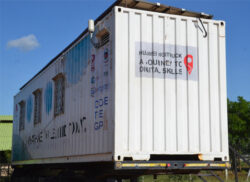
A solar-powered DigiTruck built by Huawei, a Belgian based NGO Close the Gap, the United Nations Educational, Scientific and Cultural Organization (UNESCO), Computers for Schools Kenya (CFSK) and Safaricom. The container changed into a classroom aims at getting digital literacy to the far flung areas of the country. The truck is equipped with 20 laptops, 20 Virtual Realities (VR) headsets, and has inbuilt Wi-Fi.

The approval ratings for the government’s Ajira Digital Programme remains high, survey by the Kenya Private Sector Alliance (KEPSA) states. The Programme launched in 2016 aims to link one million Kenyan youth annually to access dignified work through digital platforms over three years.

In a survey conducted by the Kenya Private Sector Alliance (KEPSA) last year more males and older generation approve of programme. The total approval of the programme stands at 79 per cent among respondents surveyed with male accounting 81 per cent while female accounts for 77 per cent. There are more males who are digital workers than females and more youth who are digital workers as compared to those aged 35 and above.

Out of respondents who had mentioned that they had done digital work, the majority mentioned that they had been involved in transcription work at 44 per cent, followed by data entry at 18 per cent and general content writing at 15 per cent. The other types of digital work done in the past months include digital marketing, website design, blogging, scientific content writing, social media campaigns, virtual assistant, graphic design, accounting, coding, online surveys among other tasks.

“A review of the type of worker by population projections shows that there are significantly more digital full time workers than part time workers,”

According to the study, the awareness of the Ajira Digital Programme has increased from 14 per cent in 2019 to 29 per cent in 2021 with the number of workers rising from 3 per cent to 5 per cent. The number of digital workers when projected to the national adult population in Kenya translates to 1,2 million in 2021. The Ajira Digital Project seeks to position Kenya as a choice of labor destination for multinational companies as well as encourage local companies and the public sector to create digital work.

The overall objective of the project is to make Kenya a freelance hub and the global destination for online work by the year 2022.

Phase one of the project provided training to 10,000 youth (8,000 inexperienced online workers with basic soft skills and introduction to online work skills and 2,000 experienced online workers with skills to scale up their business) and; mentorship for the new online workers through hand holding by the experienced online workers thus enabling young people to work online and earn an income with dignity.

The project targets to train youth (inexperienced (new) online workers) through a one week residential training. The training aims to equip the youth with basic soft skills and introduction to online work skills, digital marketing and basic financial management skills across five implementation locations in Kenya namely: Nairobi, Mombasa, Kisumu, Meru and Nakuru.

In addition, the project targets to train experienced online work freelancers through a 2 days training with an aim of equipping the selected online work freelancers with skills to scale up and develop their businesses into agencies and source for more work to share with new online workers. The experienced freelancers are ultimately expected to handhold the new online workers through one month mentorship.

Mentorship

Upon successful completion of the training, the youth are transitioned to one month mentorship through handholding by the experienced freelancers. The mentorship is aimed at enhancing the trained youth’s skills on online work thereby increasing their access to online jobs.

Media Council of Kenya undertakes journalists training. The council is charged with the responsibility of promoting high professional standards amongst journalists in Kenya and therefore conducts specialized and tailor-made trainings for media practitioners in a number of areas. The trainings aim at promoting ethical standards and professionalism among journalists and are conducted both in-house for different media houses as well as in regions. The various categories of journalists trained include: editors, reporters, correspondents, cameramen, photographers, cartoonists, freelancers and bloggers. MCK

Project Achievements

  • Curriculum for the training of inexperienced youth on online work and experienced online workers has been developed.
  • A total of 7,168 (1,984 female) youth out of the target of 8,000 have undergone training and transitioned to one month mentorship through hand holding by online work freelancers already working and earning from online work.
  • 125 experienced online work freelancers have been trained on entrepreneurship and gained skills on scaling up their online businesses

Presidential Digital Talent (DigiTalent)

Cabinet Secretary Joe Mucheru interacts with a youth participating in the Digitalent program. The Digitalent is a Public Private Partnership Programme whose key components are Skill development, on the job coaching, mentorship, training, certification and ICT innovations It is a twelve (12) month internship programme whose objective is to develop ICT high-end skills in recent graduates, offer a platform for structured training, coaching, mentoring and promote ICT innovation and solutions development

Over 2,100 interns have benefitted from President Uhuru Kenyatta’s digital talent programme launched in 2014. Most of the alumni are working in both the public and private sector while others have become entrepreneurs. The program benefits the interns by providing them with the work experience that will give them a competitive edge in the job market.

The Presidential DigiTalent Programme is an initiative of President of Kenya Uhuru Muigai Kenyatta and Implemented by the ICT Authority.

The Programme runs in cohorts and its currently in its sixth cohort. The programme on boards recently graduated ICT and ICT related courses and onboards them in the 12 months internship programme.

During the twelve months, the youths are posted to government organizations and private sector organizations to learn and know how both entities operate. During their internship period at both the private and public sector, the interns must come up with an innovation that makes a difference in process operations in any sector of the economy. The best innovations are incubated for a period of one year. The ICT Authority also looks for partners to fund the different innovations.

The programme has a mentorship pillar where youths are attached to a mentor in their area of interest who can guide them in their career growth. The mentors are used grouped into applications development, project management, Networks and security. The objectives of the programme include delivering a combination of structured training, coaching and mentoring, developing a pipeline of future talent for government with a passion for ethical and accountable public service delivery, training interns over a revolving 12-month period and creating an ICT culture transformation that treats ICT as a business in order to promote government service delivery objectives

While presiding over the virtual induction of 400 Cohort VI for the Financial Year 2021-2022, the Cabinet Secretary, Ministry of ICT, Innovation & Youth Affairs, Joe Mucheru said that the government is aware the digital economy requires highly skilled ICT talents to drive SMEs. As a result, the PDTP internship was initiated to fill the gap.

The CS also stated that the government, through the Ministry of ICT, Innovation & Youth Affairs, has been making tremendous efforts to increase connectivity and internet access to enable the uptake of technology solutions and bridge the digital divide.

Mucheru says the government remains committed to fostering a globally responsive, competitive, and adaptive ICT workforce through such programs as PDTP, Ajira Digital and Digital Literacy Programme to respond to the industry’s current and future demands on digital skills. The Principal Secretary State Department of ICT and Innovation, Jerome Ochieng’ noted that with skilled people, industries grow, and this creates more job opportunities for young people. The PDTP internship is one way through which the government is developing a pool of ICT talent to take leadership roles and prepare the country for the future.

Prof Fredrick Ochieng, the ICT Authority Board Chairman says PDTP program can help Kenya achieve its goal of ensuring that, every citizen has access to technology and that they can participate and thrive in a digital economy. Through PDTP, the ICT Authority is championing the growth of an African-wide digital economy as envisioned by President Uhuru Kenyatta. The interns undergo rigorous competitive recruitment conducted by both the public and private sectors partners. The recruitment process reflects the face of Kenya with talents being drawn from all the 47 counties.

Yearbook 2020 Factbook

Yearbook 2020 Factbook

Education